The Sun
The Sun is a yellow dwarf star (G2V), about 4.6 billion years old, and the dominant gravitational force in the Solar System. It has a diameter of roughly 1.4 million kilometers and contains around 99.8% of the Solar System’s mass. Nuclear fusion in its core converts hydrogen into helium, producing energy that warms the planets. Above the core lie the radiative and convective zones, followed by the visible photosphere (~5,500 °C), the chromosphere, and the much hotter corona (~2 million °C).
Source: science.nasa.gov
APODs including "The Sun"
Sunrise at Copernicus Crater
30/05/2019
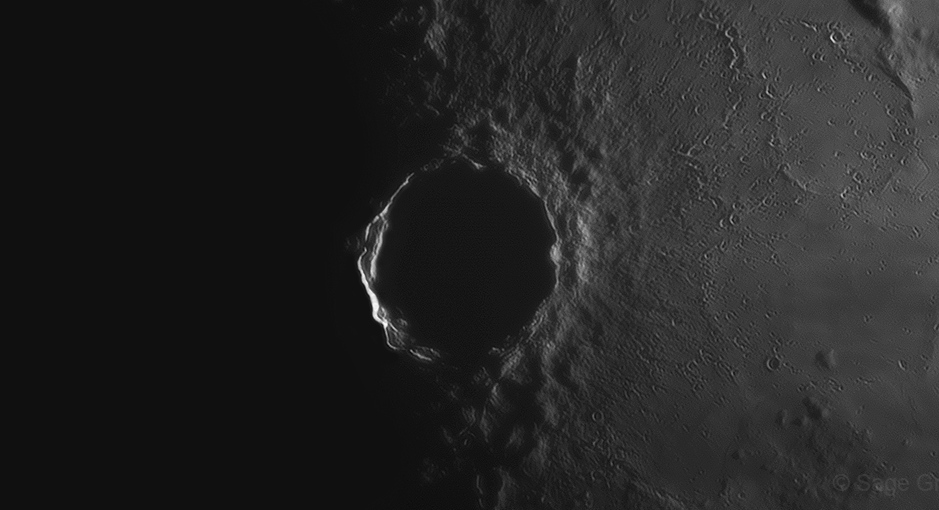
A prominent impact site anchored in the lunar Oceanus Procellarum, Copernicus crater is at the center of this telescopic portrait in light and shadow. Caught in stacked and sharpened video frames recorded on April 14 at 3:30am UTC, the lunar terminator, or boundary between night and day, cuts across the middle of the 93 kilometer diameter crater. Sunlight is just beginning to strike its tall western walls but doesn't yet shine on lower terrain nearby, briefly extending the crater's outline into the lunar nightside. At that moment standing at Copernicus crater you could watch the sunrise, an event that happens at Copernicus every 29.5 days. Of course that corresponds to a lunar month or a lunation, the time between consecutive Full Moons as seen from planet Earth.