The Sun
The Sun is a yellow dwarf star (G2V), about 4.6 billion years old, and the dominant gravitational force in the Solar System. It has a diameter of roughly 1.4 million kilometers and contains around 99.8% of the Solar System’s mass. Nuclear fusion in its core converts hydrogen into helium, producing energy that warms the planets. Above the core lie the radiative and convective zones, followed by the visible photosphere (~5,500 °C), the chromosphere, and the much hotter corona (~2 million °C).
Source: science.nasa.gov
APODs including "The Sun"
Eagle Aurora over Norway
14/07/2019
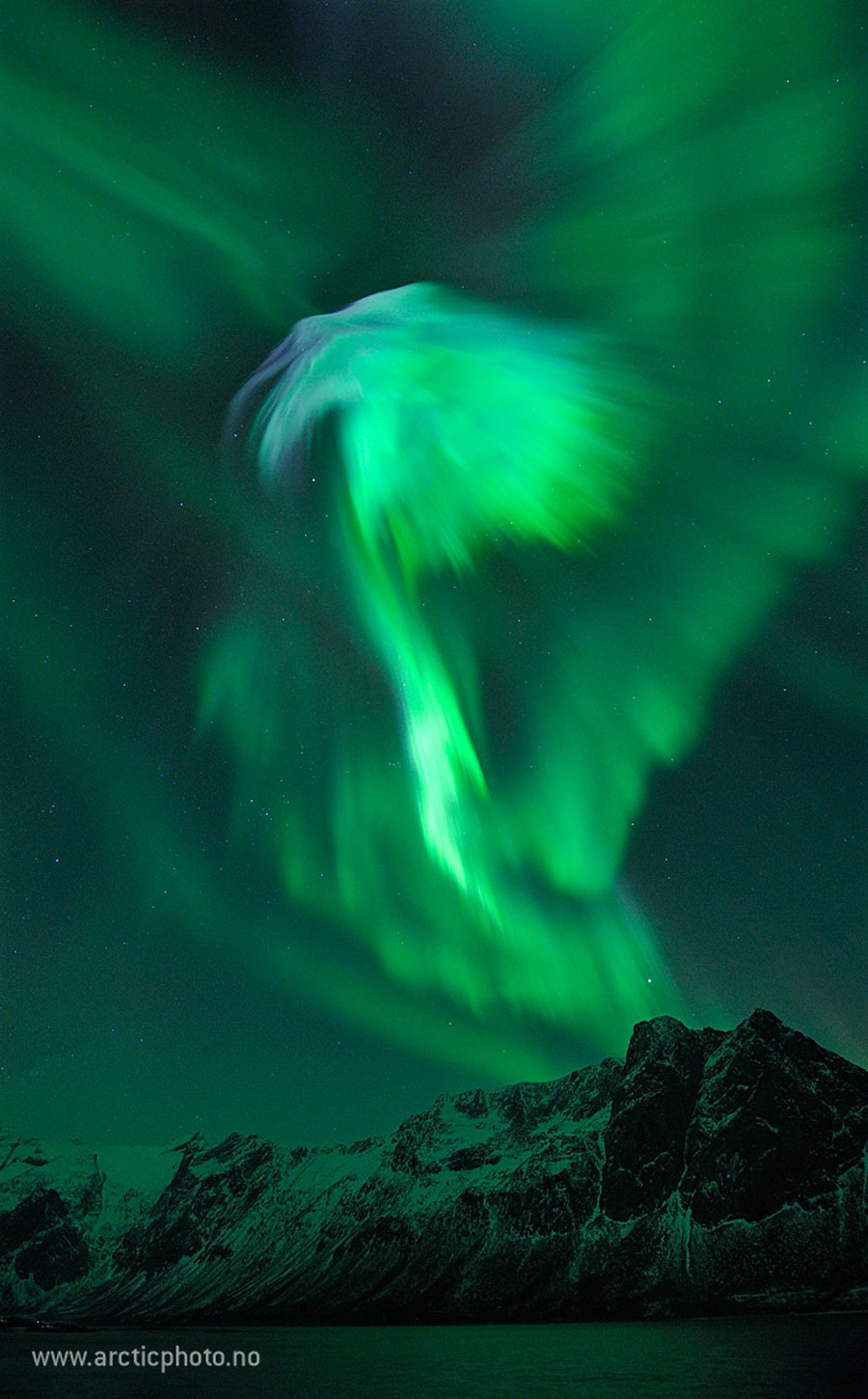
What's that in the sky? An aurora. A large coronal mass ejection occurred on our Sun five days before this 2012 image was taken, throwing a cloud of fast moving electrons, protons, and ions toward the Earth. Although most of this cloud passed above the Earth, some of it impacted our Earth's magnetosphere and resulted in spectacular auroras being seen at high northern latitudes. Featured here is a particularly photogenic auroral corona captured above Grotfjord, Norway. To some, this shimmering green glow of recombining atmospheric oxygen might appear as a large eagle, but feel free to share what it looks like to you. Although the Sun is near Solar Minimum, streams of the solar wind continue to impact the Earth and create impressive auroras visible even last week.