The Sun
The Sun is a yellow dwarf star (G2V), about 4.6 billion years old, and the dominant gravitational force in the Solar System. It has a diameter of roughly 1.4 million kilometers and contains around 99.8% of the Solar System’s mass. Nuclear fusion in its core converts hydrogen into helium, producing energy that warms the planets. Above the core lie the radiative and convective zones, followed by the visible photosphere (~5,500 °C), the chromosphere, and the much hotter corona (~2 million °C).
Source: science.nasa.gov
APODs including "The Sun"
HDR: Earth's Circular Shadow on the Moon
22/07/2019
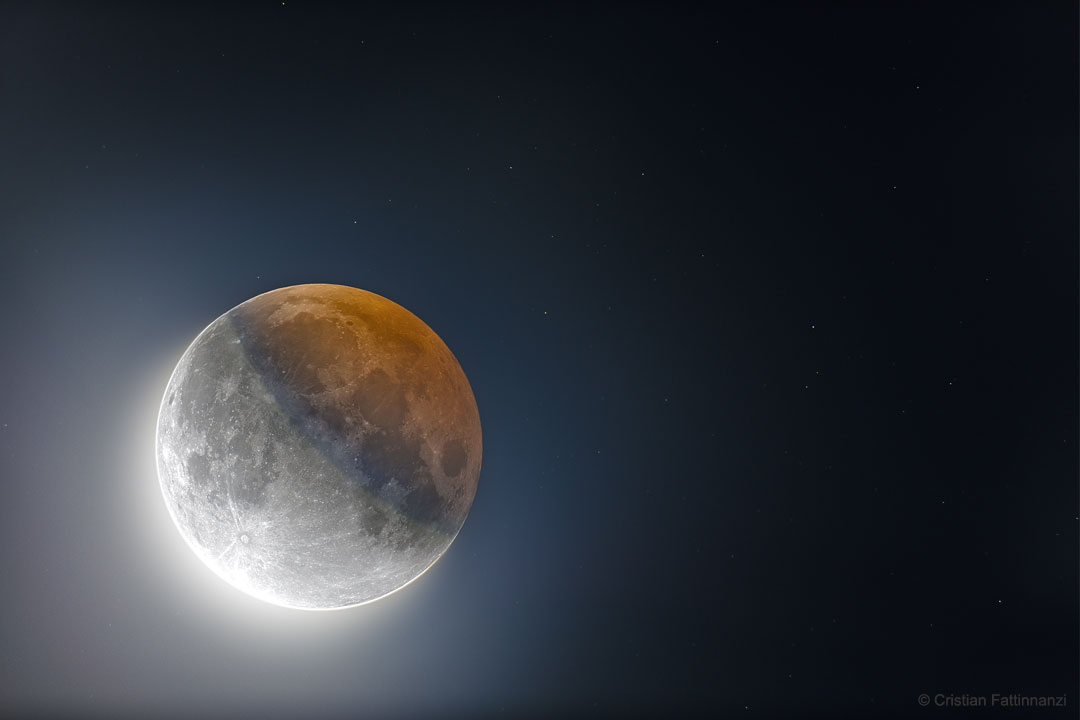
What could create such a large circular shadow on the Moon? The Earth. Last week's full Moon -- the Buck Moon -- was so full that it fell almost exactly in a line with the Sun and the Earth. When that happens the Earth casts its shadow onto the Moon. The circularity of the Earth's shadow on the Moon was commented on by Aristotle and so has been noticed since at least the 4th century BC. What's new is humanity's ability to record this shadow with such high dynamic range (HDR). The featured HDR composite of last week's partial lunar eclipse combines 15 images and include an exposure as short as 1/400th of a second -- so as not to overexpose the brightest part -- and an exposure that lasted five seconds -- to bring up the dimmest part. This dimmest part -- inside Earth's umbra -- is not completely dark because some light is refracted through the Earth's atmosphere onto the Moon. A total lunar eclipse will occur next in 2021 May. Partial Lunar Eclipse in 2019 July: Some memorable images submitted to APOD