The Sun
The Sun is a yellow dwarf star (G2V), about 4.6 billion years old, and the dominant gravitational force in the Solar System. It has a diameter of roughly 1.4 million kilometers and contains around 99.8% of the Solar System’s mass. Nuclear fusion in its core converts hydrogen into helium, producing energy that warms the planets. Above the core lie the radiative and convective zones, followed by the visible photosphere (~5,500 °C), the chromosphere, and the much hotter corona (~2 million °C).
Source: science.nasa.gov
APODs including "The Sun"
Saturn Behind the Moon
14/08/2019
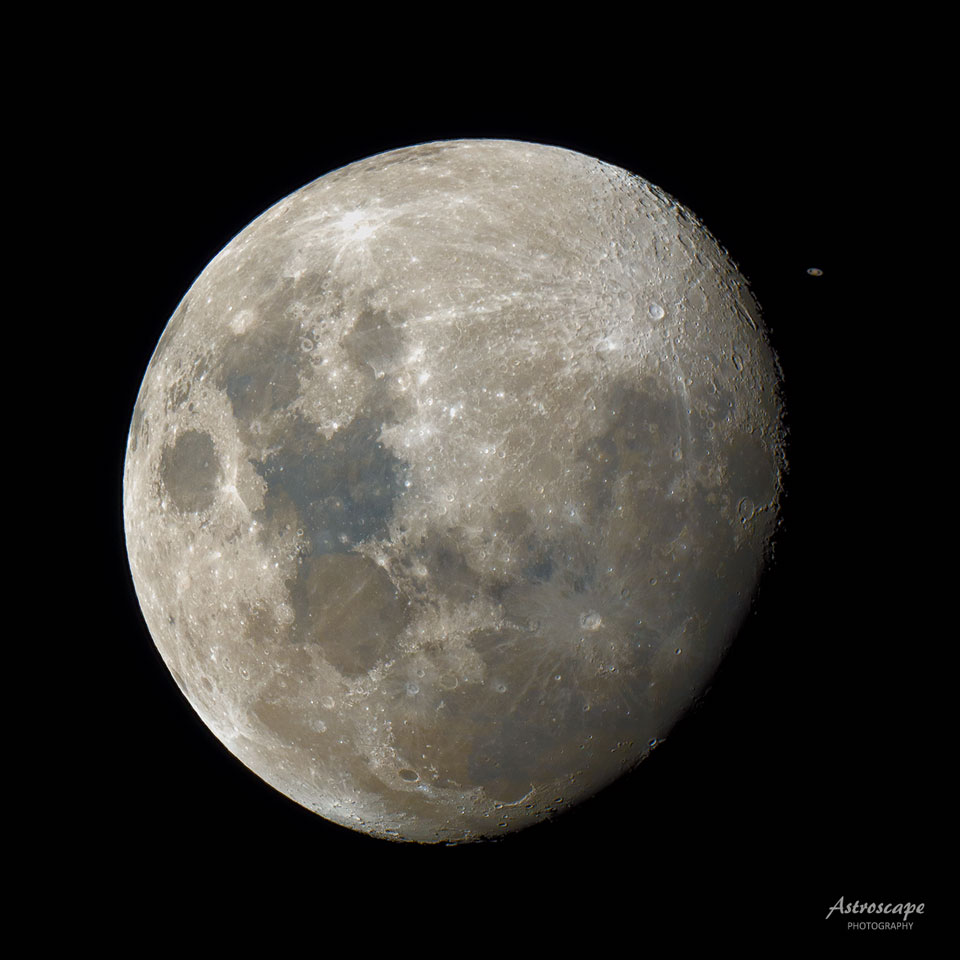
What's that next to the Moon? Saturn. In its monthly trip around the Earth -- and hence Earth's sky -- our Moon passed nearly in front of Sun-orbiting Saturn earlier this week. Actually the Moon passed directly in front of Saturn from the viewpoints of a wide swath of Earth's Southern Hemisphere. The featured image from Sydney, Australia captured the pair a few minutes before the eclipse. The image was a single shot lasting only 1/500th of a second, later processed to better highlight both the Moon and Saturn. Since Saturn is nearly opposite the Sun, it can be seen nearly the entire night, starting at sunset, toward the south and east. The gibbous Moon was also nearly opposite the Sun, and so also visible nearly the entire night -- it will be full tomorrow night. The Moon will occult Saturn again during every lap it makes around the Earth this year.