The Sun
The Sun is a yellow dwarf star (G2V), about 4.6 billion years old, and the dominant gravitational force in the Solar System. It has a diameter of roughly 1.4 million kilometers and contains around 99.8% of the Solar System’s mass. Nuclear fusion in its core converts hydrogen into helium, producing energy that warms the planets. Above the core lie the radiative and convective zones, followed by the visible photosphere (~5,500 °C), the chromosphere, and the much hotter corona (~2 million °C).
Source: science.nasa.gov
APODs including "The Sun"
Pluto in True Color
10/09/2019
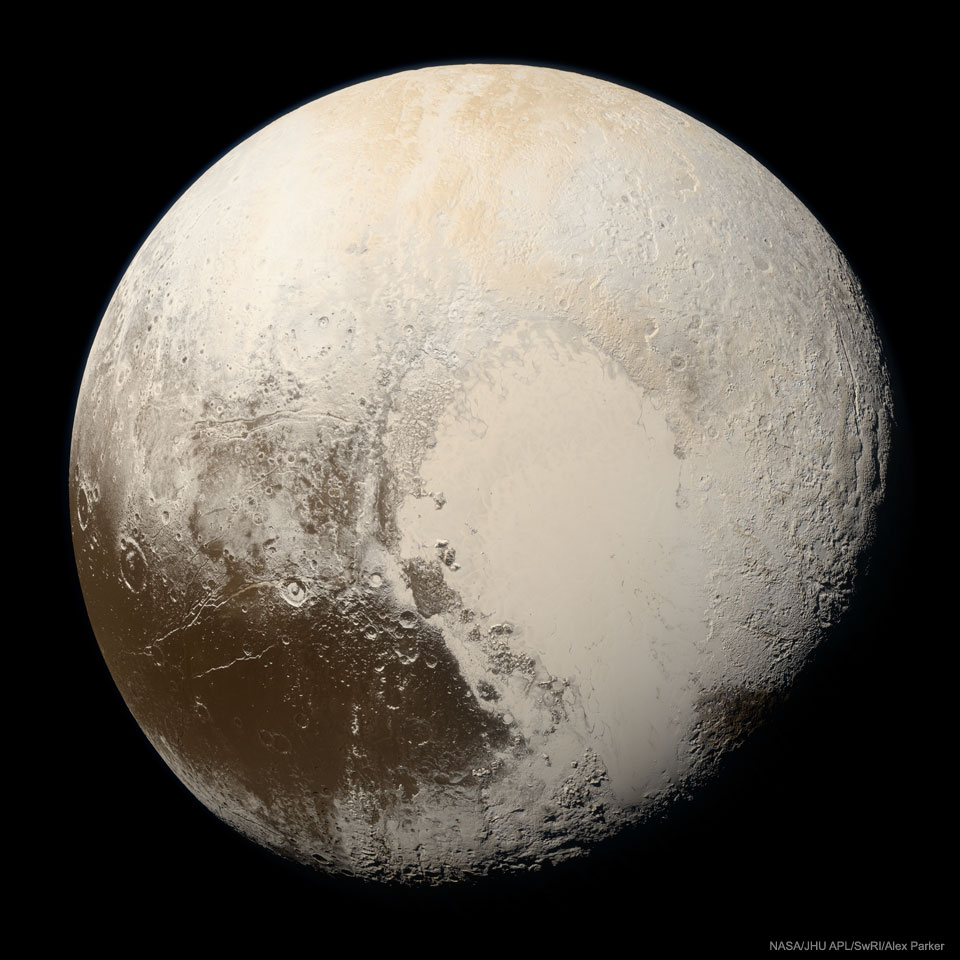
What color is Pluto, really? It took some effort to figure out. Even given all of the images sent back to Earth when the robotic New Horizons spacecraft sped past Pluto in 2015, processing these multi-spectral frames to approximate what the human eye would see was challenging. The result featured here, released three years after the raw data was acquired by New Horizons, is the highest resolution true color image of Pluto ever taken. Visible in the image is the light-colored, heart-shaped, Tombaugh Regio, with the unexpectedly smooth Sputnik Planitia, made of frozen nitrogen, filling its western lobe. New Horizons found the dwarf-planet to have a surprisingly complex surface composed of many regions having perceptibly different hues. In total, though, Pluto is mostly brown, with much of its muted color originating from small amounts of surface methane energized by ultraviolet light from the Sun.