The Sun
The Sun is a yellow dwarf star (G2V), about 4.6 billion years old, and the dominant gravitational force in the Solar System. It has a diameter of roughly 1.4 million kilometers and contains around 99.8% of the Solar System’s mass. Nuclear fusion in its core converts hydrogen into helium, producing energy that warms the planets. Above the core lie the radiative and convective zones, followed by the visible photosphere (~5,500 °C), the chromosphere, and the much hotter corona (~2 million °C).
Source: science.nasa.gov
APODs including "The Sun"
Io Eclipse Shadow on Jupiter from Juno
07/10/2019
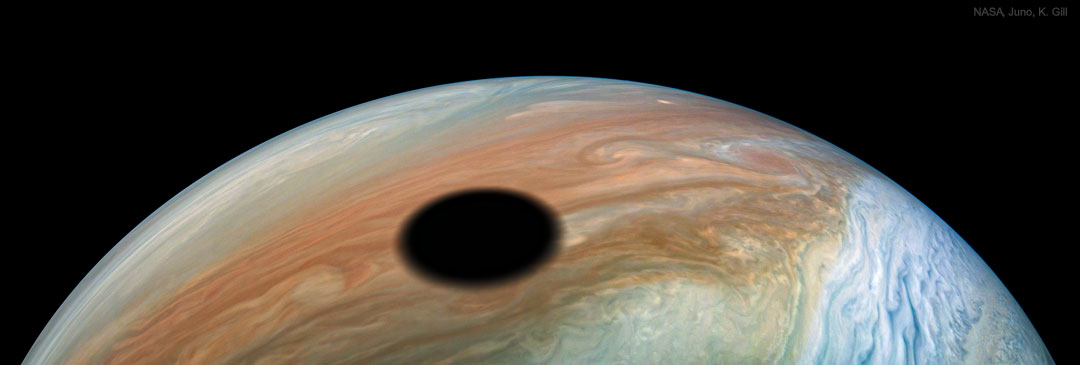
What's that dark spot on Jupiter? It's the shadow of Jupiter's most volcanic moon Io. Since Jupiter shines predominantly by reflected sunlight, anything that blocks that light leaves a shadow. If you could somehow be in that shadow, you would see a total eclipse of the Sun by Io. Io's shadow is about 3600 kilometers across, roughly the same size as Io itself -- and only slightly larger than Earth's Moon. The featured image was taken last month by NASA's robotic Juno spacecraft currently orbiting Jupiter. About every two months, Juno swoops close by Jupiter, takes a lot of data and snaps a series of images -- some of which are made into a video. Among many other things, Juno has been measuring Jupiter's gravitational field, finding surprising evidence that Jupiter may be mostly a liquid. Under unexpectedly thick clouds, the Jovian giant may house a massive liquid hydrogen region that extends all the way to the center.