The Sun
The Sun is a yellow dwarf star (G2V), about 4.6 billion years old, and the dominant gravitational force in the Solar System. It has a diameter of roughly 1.4 million kilometers and contains around 99.8% of the Solar System’s mass. Nuclear fusion in its core converts hydrogen into helium, producing energy that warms the planets. Above the core lie the radiative and convective zones, followed by the visible photosphere (~5,500 °C), the chromosphere, and the much hotter corona (~2 million °C).
Source: science.nasa.gov
APODs including "The Sun"
Daphnis and the Rings of Saturn
03/11/2019
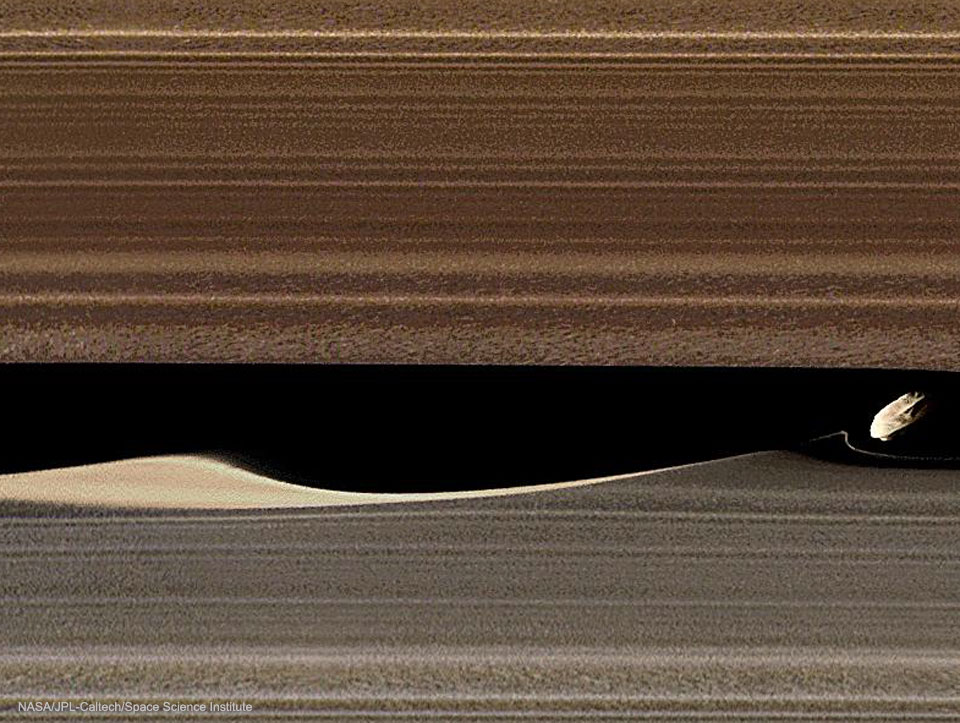
What's happening to the rings of Saturn? A little moon making big waves. The moon is 8-kilometer Daphnis and it is making waves in the Keeler Gap of Saturn's rings using just its gravity -- as it bobs up and down, in and out. The featured image is a colored and more detailed version of a previously released images taken in 2017 by the robotic Cassini spacecraft during one of its Grand Finale orbits. Daphnis can be seen on the far right, sporting ridges likely accumulated from ring particles. Daphnis was discovered in Cassini images in 2005 and raised mounds of ring particles so high in 2009 -- during Saturn's equinox when the ring plane pointed directly at the Sun -- that they cast notable shadows.