The Sun
The Sun is a yellow dwarf star (G2V), about 4.6 billion years old, and the dominant gravitational force in the Solar System. It has a diameter of roughly 1.4 million kilometers and contains around 99.8% of the Solar System’s mass. Nuclear fusion in its core converts hydrogen into helium, producing energy that warms the planets. Above the core lie the radiative and convective zones, followed by the visible photosphere (~5,500 °C), the chromosphere, and the much hotter corona (~2 million °C).
Source: science.nasa.gov
APODs including "The Sun"
The Hyades Star Cluster
22/01/2020
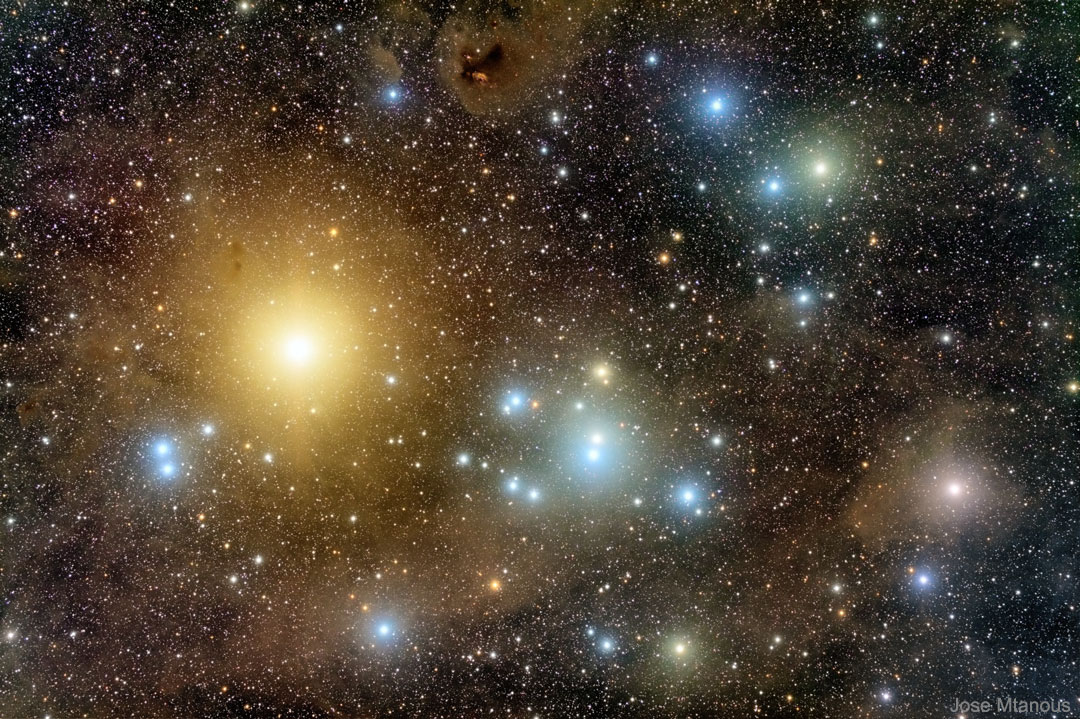
It is the closest cluster of stars to the Sun. The Hyades open cluster is bright enough to have been remarked on even thousands of years ago, yet is not as bright or compact as the nearby Pleiades (M45) star cluster. Pictured here is a particularly deep image of the Hyades which has brings out vivid star colors and faint coincidental nebulas. The brightest star in the field is yellow Aldebaran, the eye of the bull toward the constellation of Taurus. Aldebaran, at 65 light-years away, is now known to be unrelated to the Hyades cluster, which lies about 150 light-years away. The central Hyades stars are spread out over about 15 light-years. Formed about 625 million years ago, the Hyades likely shares a common origin with the Beehive cluster (M44), a naked-eye open star cluster toward the constellation of Cancer, based on M44's motion through space and remarkably similar age.