The Sun
The Sun is a yellow dwarf star (G2V), about 4.6 billion years old, and the dominant gravitational force in the Solar System. It has a diameter of roughly 1.4 million kilometers and contains around 99.8% of the Solar System’s mass. Nuclear fusion in its core converts hydrogen into helium, producing energy that warms the planets. Above the core lie the radiative and convective zones, followed by the visible photosphere (~5,500 °C), the chromosphere, and the much hotter corona (~2 million °C).
Source: science.nasa.gov
APODs including "The Sun"
The Pale Blue Dot
14/02/2020
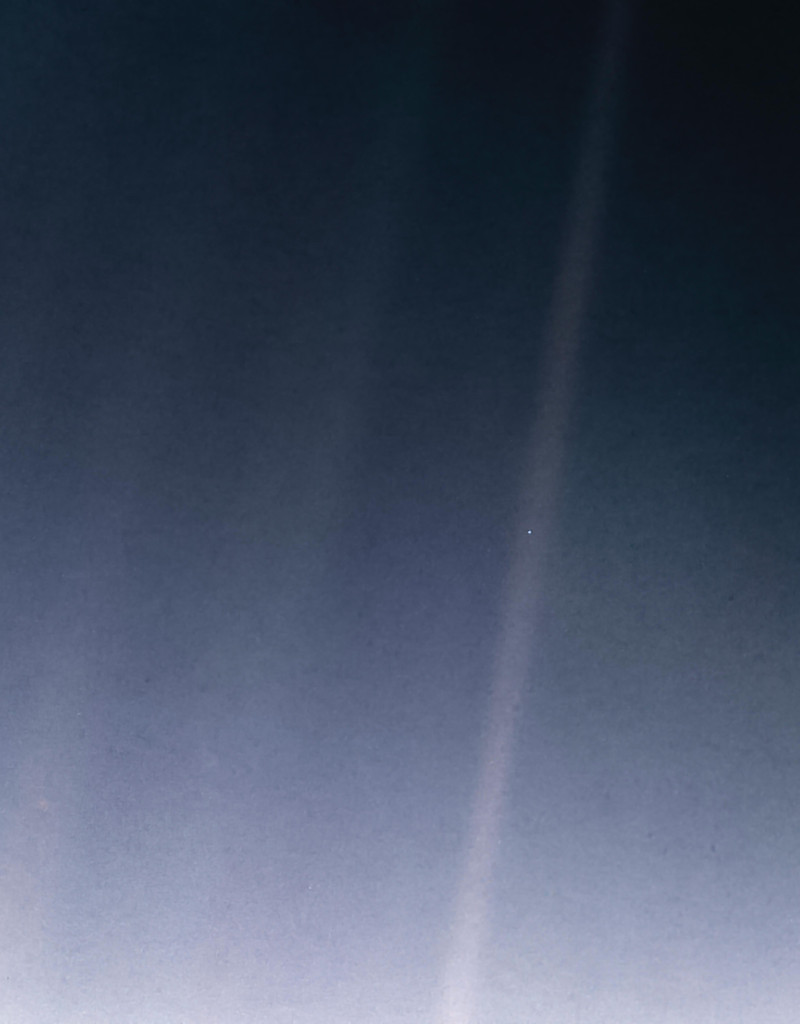
On Valentine's Day in 1990, cruising four billion miles from the Sun, the Voyager 1 spacecraft looked back one last time to make the first ever Solar System family portrait. The portrait consists of the Sun and six planets in a 60 frame mosaic made from a vantage point 32 degrees above the ecliptic plane. Planet Earth was captured within a single pixel in this single frame. It's the pale blue dot within the sunbeam just right of center in this reprocessed version of the now famous view from Voyager. Astronomer Carl Sagan originated the idea of using Voyager's camera to look back toward home from a distant perspective. Thirty years later, on this Valentine's day, look again at the pale blue dot.