The Sun
The Sun is a yellow dwarf star (G2V), about 4.6 billion years old, and the dominant gravitational force in the Solar System. It has a diameter of roughly 1.4 million kilometers and contains around 99.8% of the Solar System’s mass. Nuclear fusion in its core converts hydrogen into helium, producing energy that warms the planets. Above the core lie the radiative and convective zones, followed by the visible photosphere (~5,500 °C), the chromosphere, and the much hotter corona (~2 million °C).
Source: science.nasa.gov
APODs including "The Sun"
Two Hemisphere Night Sky
27/02/2020
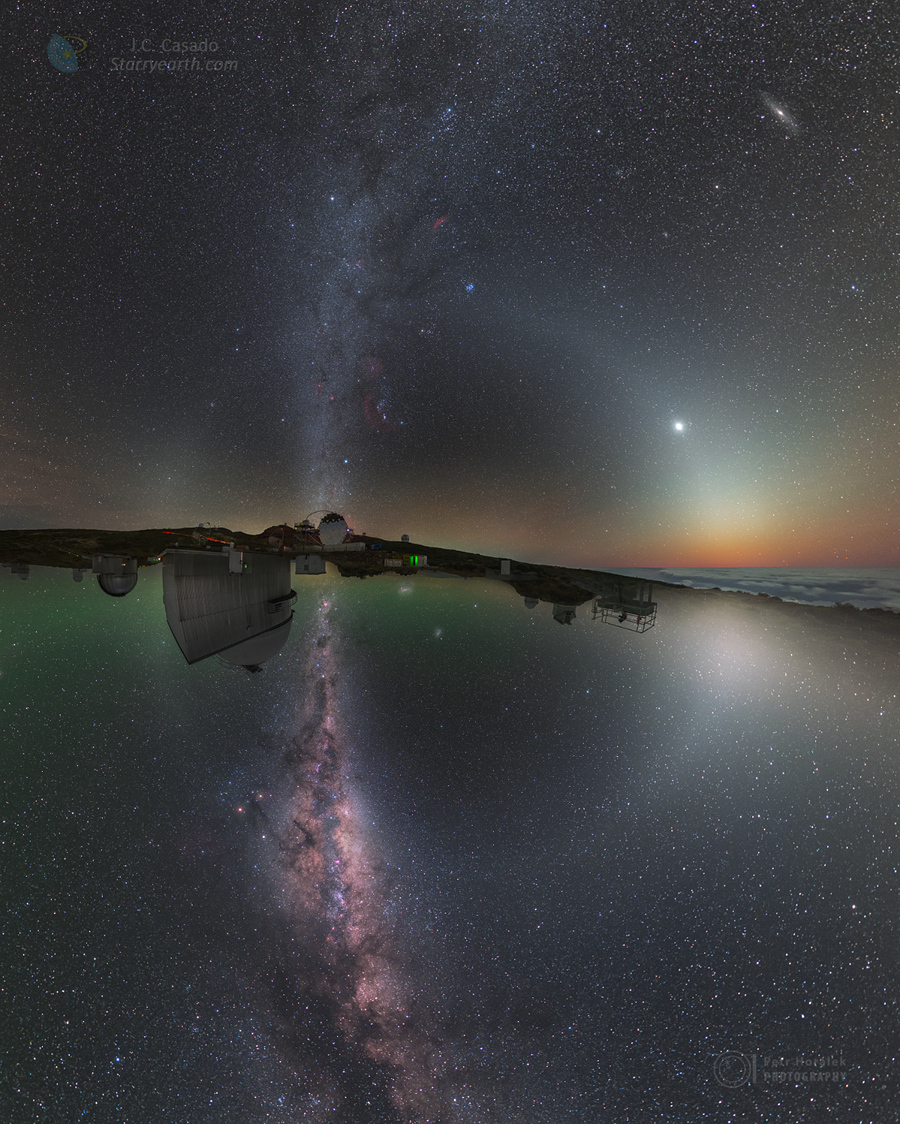
The Sun is hidden by a horizon that runs across the middle in this two hemisphere view of Earth's night sky. The digitally stitched mosaics were recorded from corresponding latitudes, one 29 degrees north and one 29 degrees south of the planet's equator. On top is the northern view from the IAC observatory at La Palma taken in February 2020. Below is a well-matched southern scene from the ESO La Silla Observatory recorded in April 2016. In this projection, the Milky Way runs almost vertically above and below the horizon. Its dark clouds and and bright nebulae are prominent near the galactic center in the lower half of the frame. In the upper half, brilliant Venus is immersed in zodiacal light. Sunlight faintly scattered by interplanetary dust, the zodiacal light traces the Solar System's ecliptic plane in a complete circle through the starry sky. Large telescope domes bulge along the inverted horizon from La Silla while at La Palma, multi-mirror Magic telescopes stand above center. Explore this two hemisphere night sky and you can also find the Andromeda Galaxy and the Large and Small Magellanic Clouds.