The Sun
The Sun is a yellow dwarf star (G2V), about 4.6 billion years old, and the dominant gravitational force in the Solar System. It has a diameter of roughly 1.4 million kilometers and contains around 99.8% of the Solar System’s mass. Nuclear fusion in its core converts hydrogen into helium, producing energy that warms the planets. Above the core lie the radiative and convective zones, followed by the visible photosphere (~5,500 °C), the chromosphere, and the much hotter corona (~2 million °C).
Source: science.nasa.gov
APODs including "The Sun"
South Celestial Rocket Launch
28/02/2020
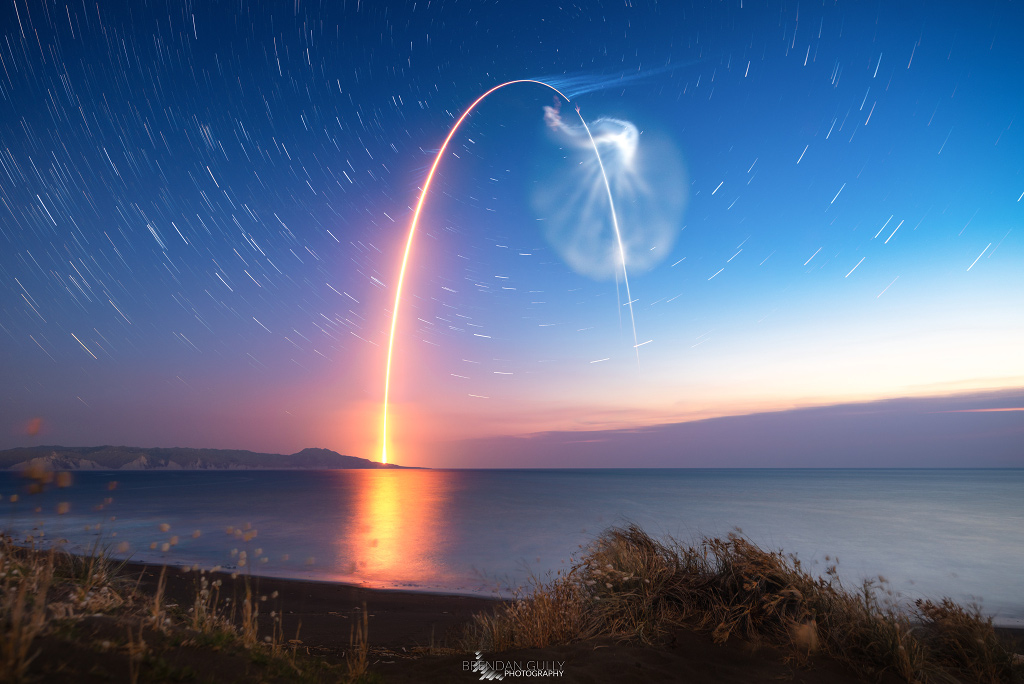
At sunset on December 6 a Rocket Lab Electron rocket was launched from a rotating planet. With multiple small satellites on board it departed on a mission to low Earth orbit dubbed Running Out of Fingers from Mahia Peninsula on New Zealand's north island. The fiery trace of the Electron's graceful launch arc is toward the south in this southern sea and skyscape. Drifting vapor trails and rocket exhaust plumes catch the sunlight even as the sky grows dark though, the setting Sun still shinning at altitude along the rocket's trajectory. Fixed to a tripod, the camera's perspective nearly aligns the peak of the rocket arc with the South Celestial Pole, but no bright star marks that location in the southern hemisphere's evening sky. Still, it's easy to find at the center of the star trail arcs in the timelapse composite.