The Sun
The Sun is a yellow dwarf star (G2V), about 4.6 billion years old, and the dominant gravitational force in the Solar System. It has a diameter of roughly 1.4 million kilometers and contains around 99.8% of the Solar System’s mass. Nuclear fusion in its core converts hydrogen into helium, producing energy that warms the planets. Above the core lie the radiative and convective zones, followed by the visible photosphere (~5,500 °C), the chromosphere, and the much hotter corona (~2 million °C).
Source: science.nasa.gov
APODs including "The Sun"
A Moon Dressed Like Saturn
16/03/2020
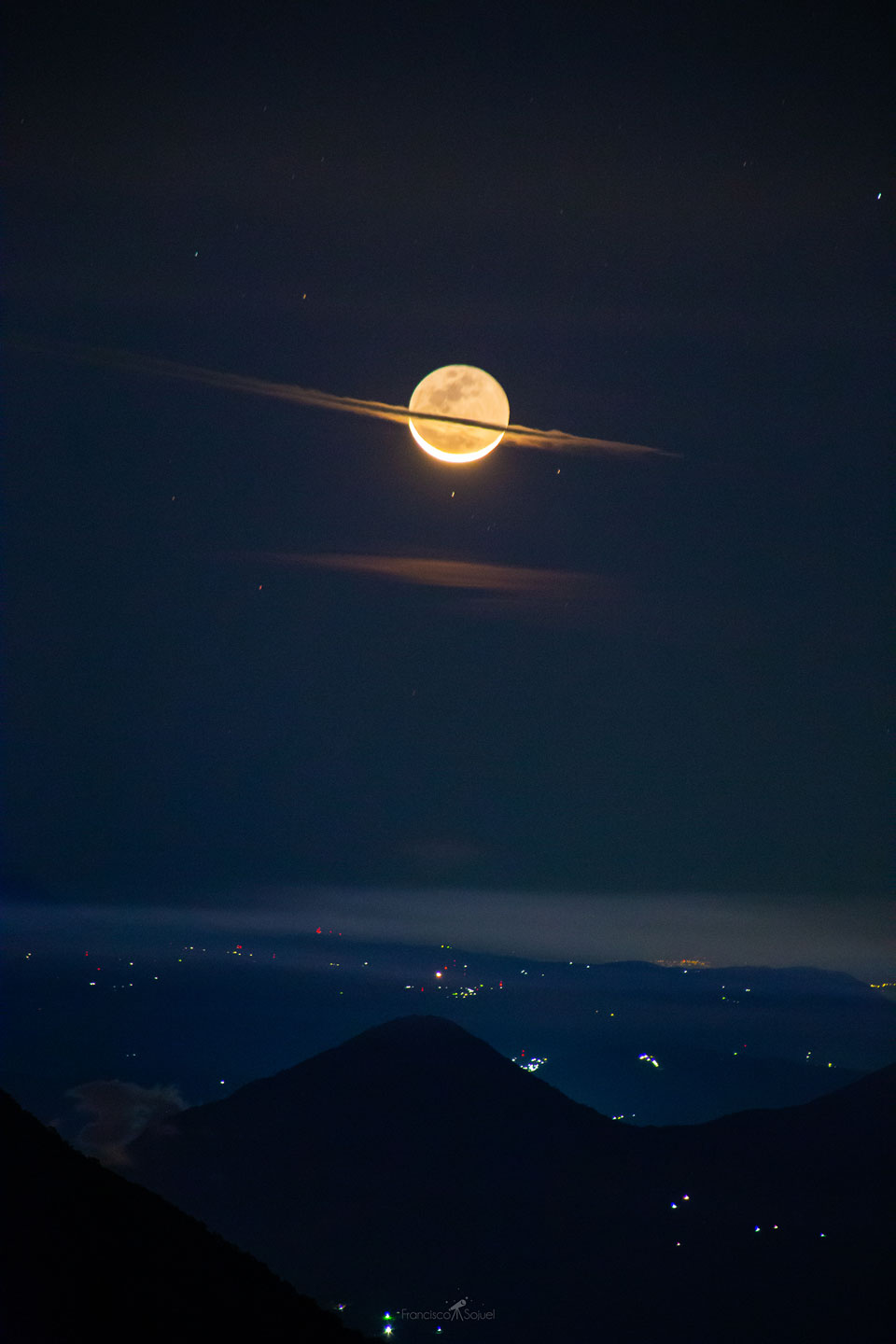
Why does Saturn appear so big? It doesn't -- what is pictured are foreground clouds on Earth crossing in front of the Moon. The Moon shows a slight crescent phase with most of its surface visible by reflected Earthlight known as ashen glow. The Sun directly illuminates the brightly lit lunar crescent from the bottom, which means that the Sun must be below the horizon and so the image was taken before sunrise. This double take-inducing picture was captured on 2019 December 24, two days before the Moon slid in front of the Sun to create a solar eclipse. In the foreground, lights from small Guatemalan towns are visible behind the huge volcano Pacaya. Follow APOD in English on: Instagram, Facebook, Reddit, or Twitter