The Sun
The Sun is a yellow dwarf star (G2V), about 4.6 billion years old, and the dominant gravitational force in the Solar System. It has a diameter of roughly 1.4 million kilometers and contains around 99.8% of the Solar System’s mass. Nuclear fusion in its core converts hydrogen into helium, producing energy that warms the planets. Above the core lie the radiative and convective zones, followed by the visible photosphere (~5,500 °C), the chromosphere, and the much hotter corona (~2 million °C).
Source: science.nasa.gov
APODs including "The Sun"
A Flow of Time
09/04/2020
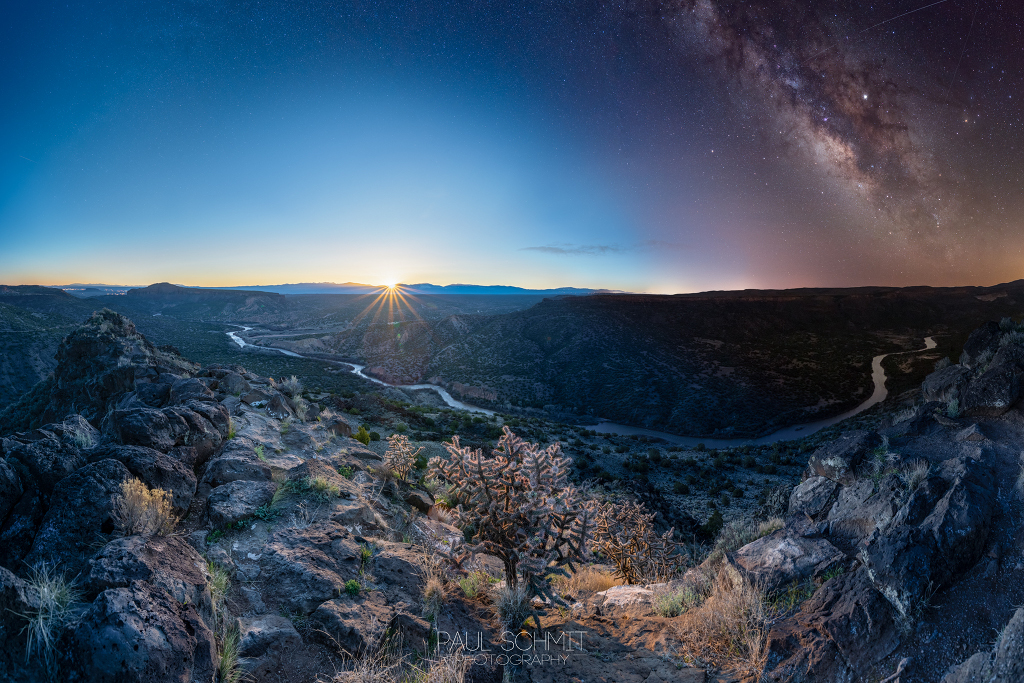
This surreal timelapse, landscape, panorama spans predawn, blue hour, and sunrise skies. Close to the start of planet Earth's northern hemisphere spring, the flow of time was captured between 4:30 and 7:00 am from a location overlooking northern New Mexico's Rio Grande Valley. In tracked images of the night sky just before twilight begins, the Milky Way is cast across the southern (right) edge of the panoramic frame. Toward the east, a range of short and long exposures resolves the changing brightness as the Sun rises over the distant peaks of the Sangre de Cristo Mountains. In between, exposures made during the spring morning's tantalizing blue hour are used to blend the night sky and sunrise over the high desert landscape.