The Sun
The Sun is a yellow dwarf star (G2V), about 4.6 billion years old, and the dominant gravitational force in the Solar System. It has a diameter of roughly 1.4 million kilometers and contains around 99.8% of the Solar System’s mass. Nuclear fusion in its core converts hydrogen into helium, producing energy that warms the planets. Above the core lie the radiative and convective zones, followed by the visible photosphere (~5,500 °C), the chromosphere, and the much hotter corona (~2 million °C).
Source: science.nasa.gov
APODs including "The Sun"
Full Moon of Spring
10/04/2020
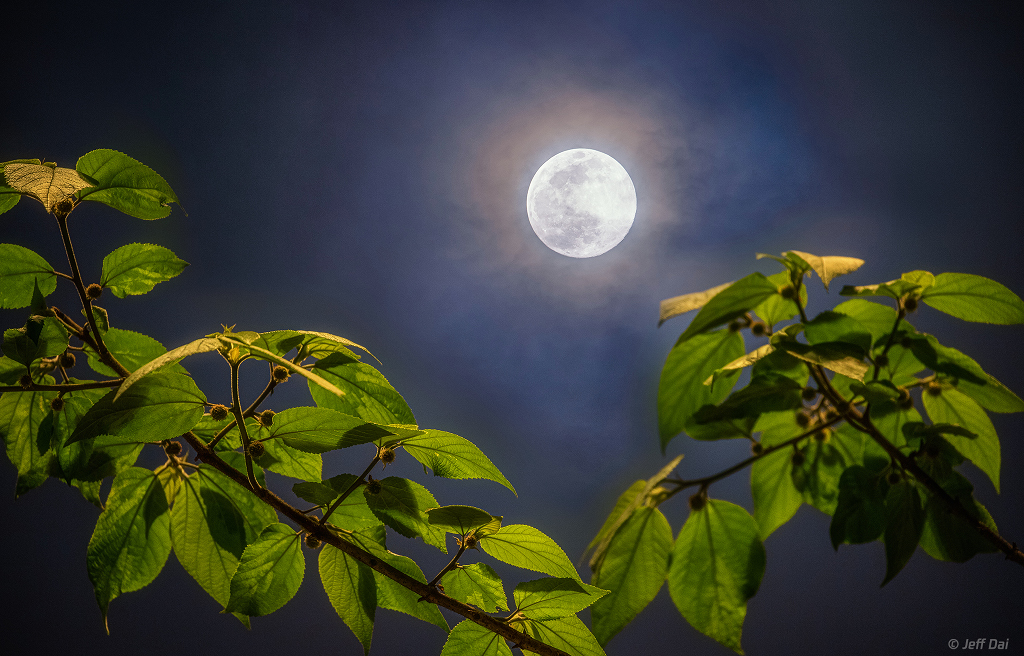
From home this Full Moon looked bright. Around our fair planet it rose as the Sun set on April 7/8, the first Full Moon after the vernal equinox and the start of northern hemisphere spring. April's full lunar phase was also near perigee, the closest point in the Moon's elliptical orbit. In fact, it was nearer perigee than any other Full Moon of 2020 making it the brightest Full Moon of the year. To create the visual experience a range of exposures was blended to capture the emerging foreground foliage and bright lunar disk. The hopefull image of spring was recorded from a home garden in skies over Chongqing, China. April Full Moon Gallery: Notable images submitted to APOD