The Sun
The Sun is a yellow dwarf star (G2V), about 4.6 billion years old, and the dominant gravitational force in the Solar System. It has a diameter of roughly 1.4 million kilometers and contains around 99.8% of the Solar System’s mass. Nuclear fusion in its core converts hydrogen into helium, producing energy that warms the planets. Above the core lie the radiative and convective zones, followed by the visible photosphere (~5,500 °C), the chromosphere, and the much hotter corona (~2 million °C).
Source: science.nasa.gov
APODs including "The Sun"
Hubble's Cosmic Reef
25/04/2020
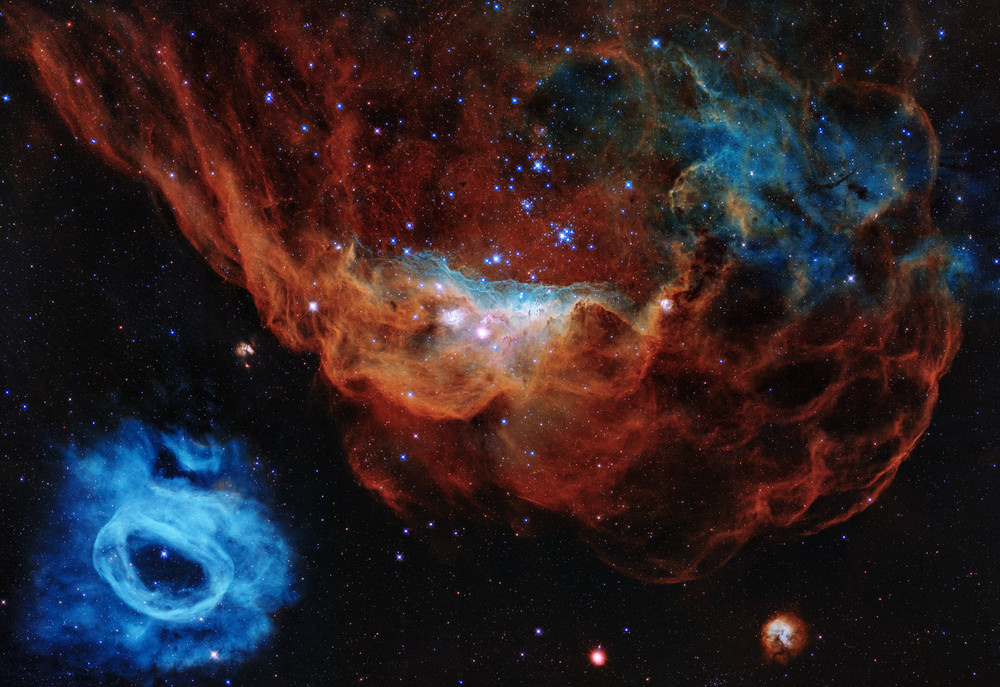
These bright ridges of interstellar gas and dust are bathed in energetic starlight. With its sea of young stars, the massive star-forming region NGC 2014 has been dubbed the Cosmic Reef. Drifting just off shore, the smaller NGC 2020, is an expansive blue-hued structure erupting from a single central Wolf-Rayet star, 200,000 times brighter than the Sun. The cosmic frame spans some 600 light-years within the Large Magellanic Cloud 160,000 light-years away, a satellite galaxy of our Milky Way. A magnificent Hubble Space Telescope portrait, the image was released this week as part of a celebration to mark Hubble's 30th year exploring the Universe from Earth orbit.