The Sun
The Sun is a yellow dwarf star (G2V), about 4.6 billion years old, and the dominant gravitational force in the Solar System. It has a diameter of roughly 1.4 million kilometers and contains around 99.8% of the Solar System’s mass. Nuclear fusion in its core converts hydrogen into helium, producing energy that warms the planets. Above the core lie the radiative and convective zones, followed by the visible photosphere (~5,500 °C), the chromosphere, and the much hotter corona (~2 million °C).
Source: science.nasa.gov
APODs including "The Sun"
The Ion Tail of New Comet SWAN
29/04/2020
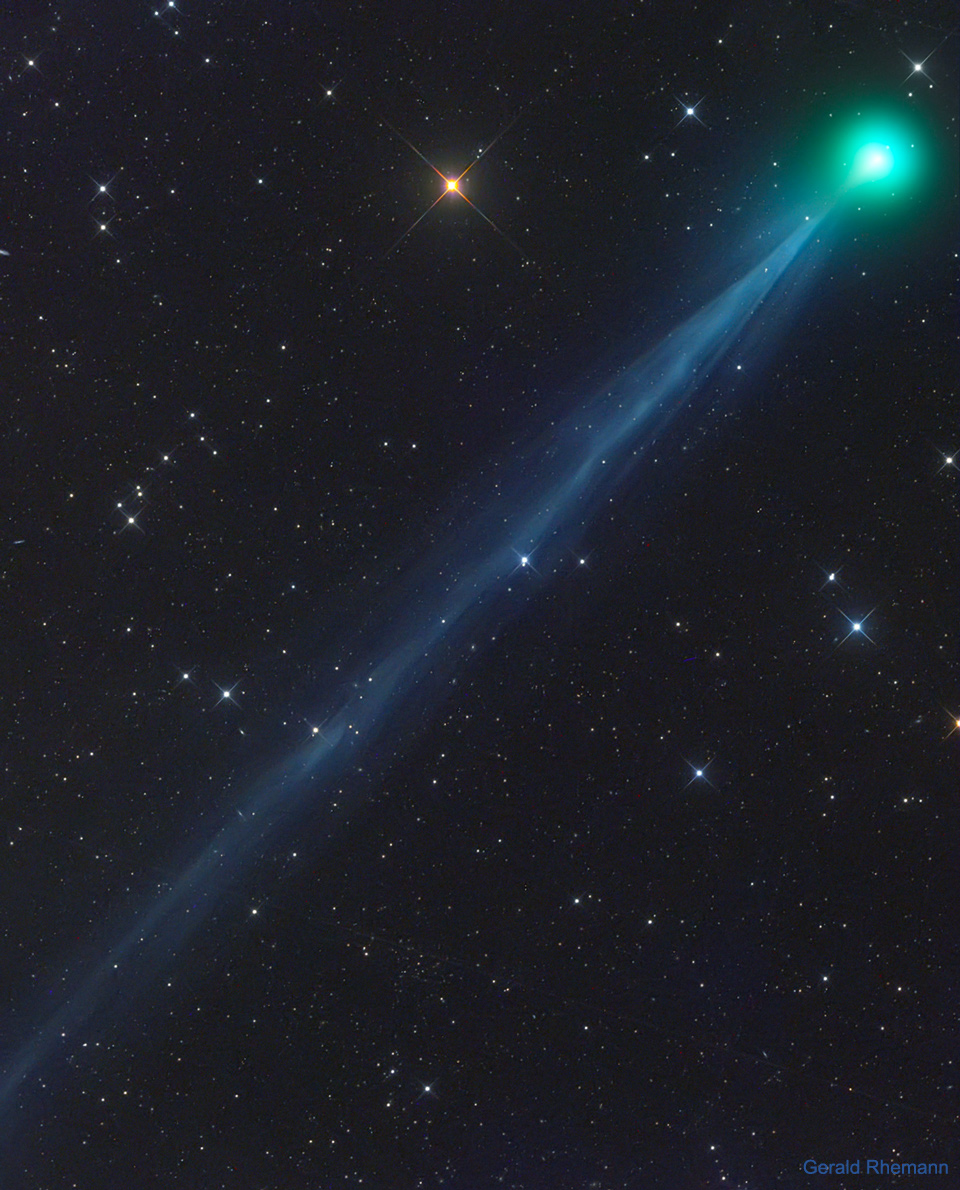
Newly discovered Comet SWAN has already developed an impressive tail. The comet came in from the outer Solar System and has just passed inside the orbit of the Earth. Officially designated C/2020 F8 (SWAN), this outgassing interplanetary iceberg will pass its closest to the Earth on May 13, and closest to the Sun on May 27. The comet was first noticed in late March by an astronomy enthusiast looking through images taken by ESA's and NASA's Sun-orbiting SOHO spacecraft, and is named for this spacecraft's Solar Wind Anisotropies (SWAN) camera. The featured image, taken from the dark skies in Namibia in mid-April, captured Comet SWAN's green-glowing coma and unexpectedly long, detailed, and blue ion-tail. Although the brightness of comets are notoriously hard to predict, some models have Comet SWAN becoming bright enough to see with the unaided eye during June. Experts Debate: How will humanity first discover extraterrestrial life?