The Sun
The Sun is a yellow dwarf star (G2V), about 4.6 billion years old, and the dominant gravitational force in the Solar System. It has a diameter of roughly 1.4 million kilometers and contains around 99.8% of the Solar System’s mass. Nuclear fusion in its core converts hydrogen into helium, producing energy that warms the planets. Above the core lie the radiative and convective zones, followed by the visible photosphere (~5,500 °C), the chromosphere, and the much hotter corona (~2 million °C).
Source: science.nasa.gov
APODs including "The Sun"
Long Tailed Comet SWAN
08/05/2020
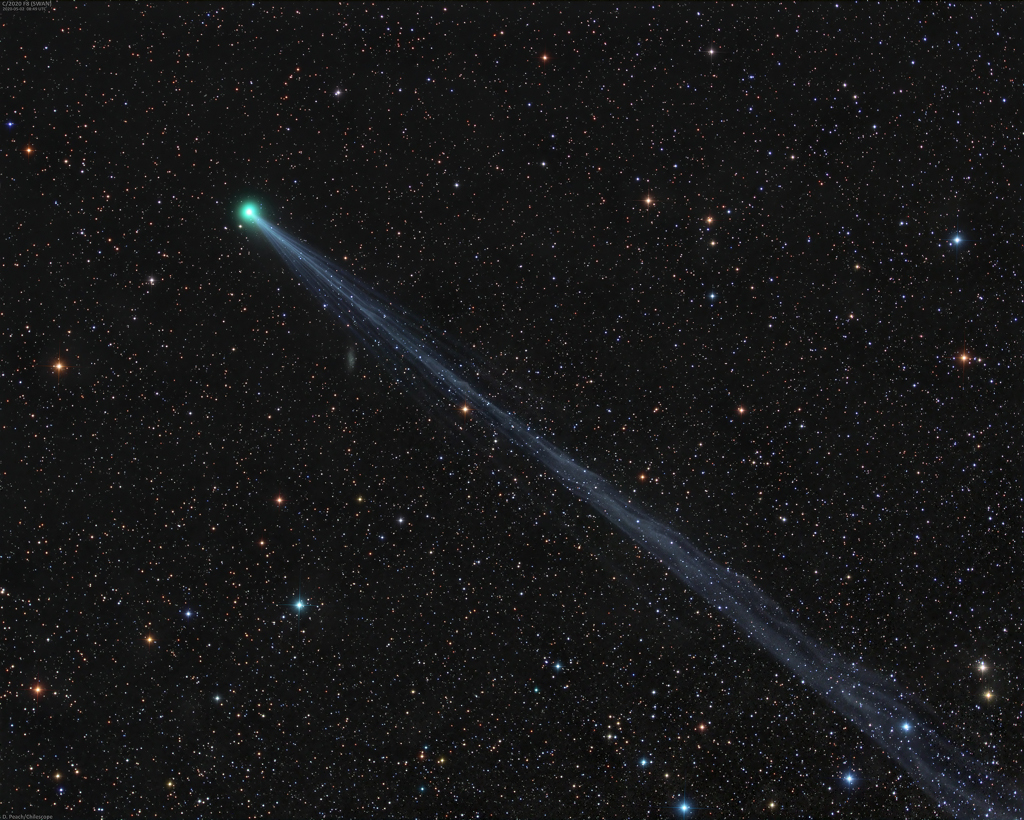
Blowing in the solar wind the spectacular ion tail of Comet SWAN (C/2020 F8) extends far across this 10 degree wide telephoto field of view. Captured on May 2 its greenish coma was about 6 light-minutes from Earth. The pretty background starfield lies near the border of the constellations Cetus and Aquarius. This comet SWAN was discovered at home by Australian amateur Michael Mattiazzo by checking images from the Sun-staring SOHO spacecraft's SWAN (Solar Wind ANisotropies) camera. The comet has now become just visible to the naked-eye as it sweeps from southern to northern skies. Appearing in morning twilight near the eastern horizon, Comet SWAN will make its closest approach to planet Earth on May 12 and reach perihelion on May 27.