The Sun
The Sun is a yellow dwarf star (G2V), about 4.6 billion years old, and the dominant gravitational force in the Solar System. It has a diameter of roughly 1.4 million kilometers and contains around 99.8% of the Solar System’s mass. Nuclear fusion in its core converts hydrogen into helium, producing energy that warms the planets. Above the core lie the radiative and convective zones, followed by the visible photosphere (~5,500 °C), the chromosphere, and the much hotter corona (~2 million °C).
Source: science.nasa.gov
APODs including "The Sun"
Mercury Meets Crescent Venus
29/05/2020
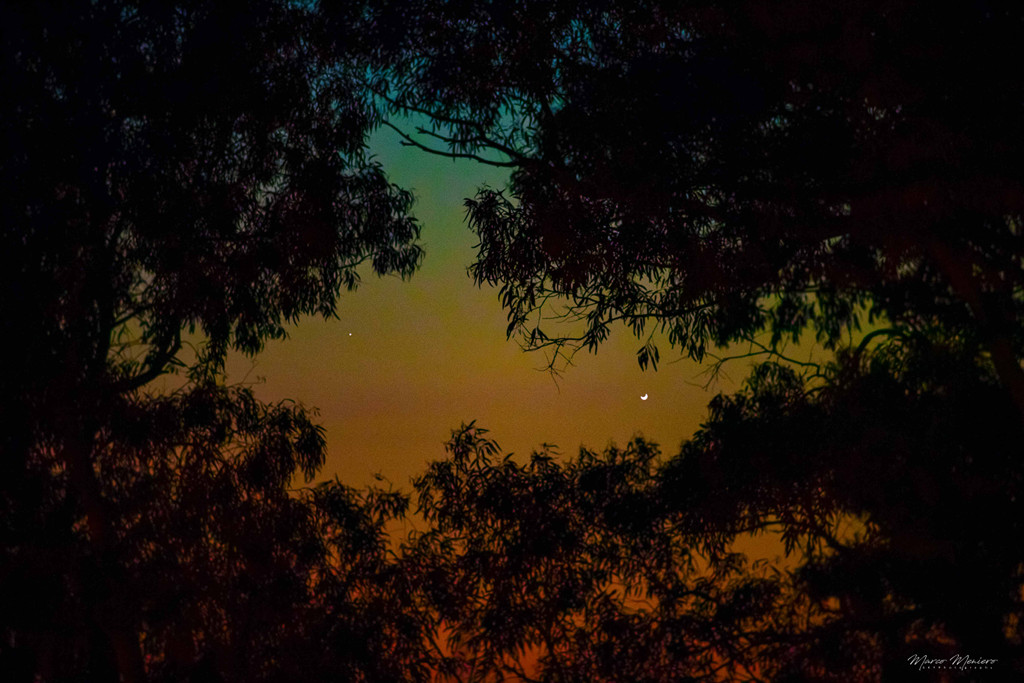
That's not a bright star and crescent Moon caught between branches of a eucalyptus tree. It's Venus in a crescent phase and Mercury. Near the western horizon after sunset, the two inner planets closely shared this telescopic field of view on May 22, seen from a balcony in Civitavecchia, Italy. Venus, the very bright celestial beacon, is wandering lower into the evening twilight. It grows larger in apparent size and shows a thinner crescent as it heads toward its inferior conjunction, positioned between Earth and Sun on June 3. Mercury, in a fuller phase, is climbing in the western sky though, reaching its maximum angular distance from the Sun on June 4 Still, this remarkably close pairing with brilliant Venus made Mercury, usually lost in bright twilight skies, easier to spot from planet Earth. Gallery: Notable Venus & Mercury Conjunction 2020 Images submitted to APOD