The Sun
The Sun is a yellow dwarf star (G2V), about 4.6 billion years old, and the dominant gravitational force in the Solar System. It has a diameter of roughly 1.4 million kilometers and contains around 99.8% of the Solar System’s mass. Nuclear fusion in its core converts hydrogen into helium, producing energy that warms the planets. Above the core lie the radiative and convective zones, followed by the visible photosphere (~5,500 °C), the chromosphere, and the much hotter corona (~2 million °C).
Source: science.nasa.gov
APODs including "The Sun"
Green Flashes: Sun, Moon, Venus, Mercury
30/05/2020
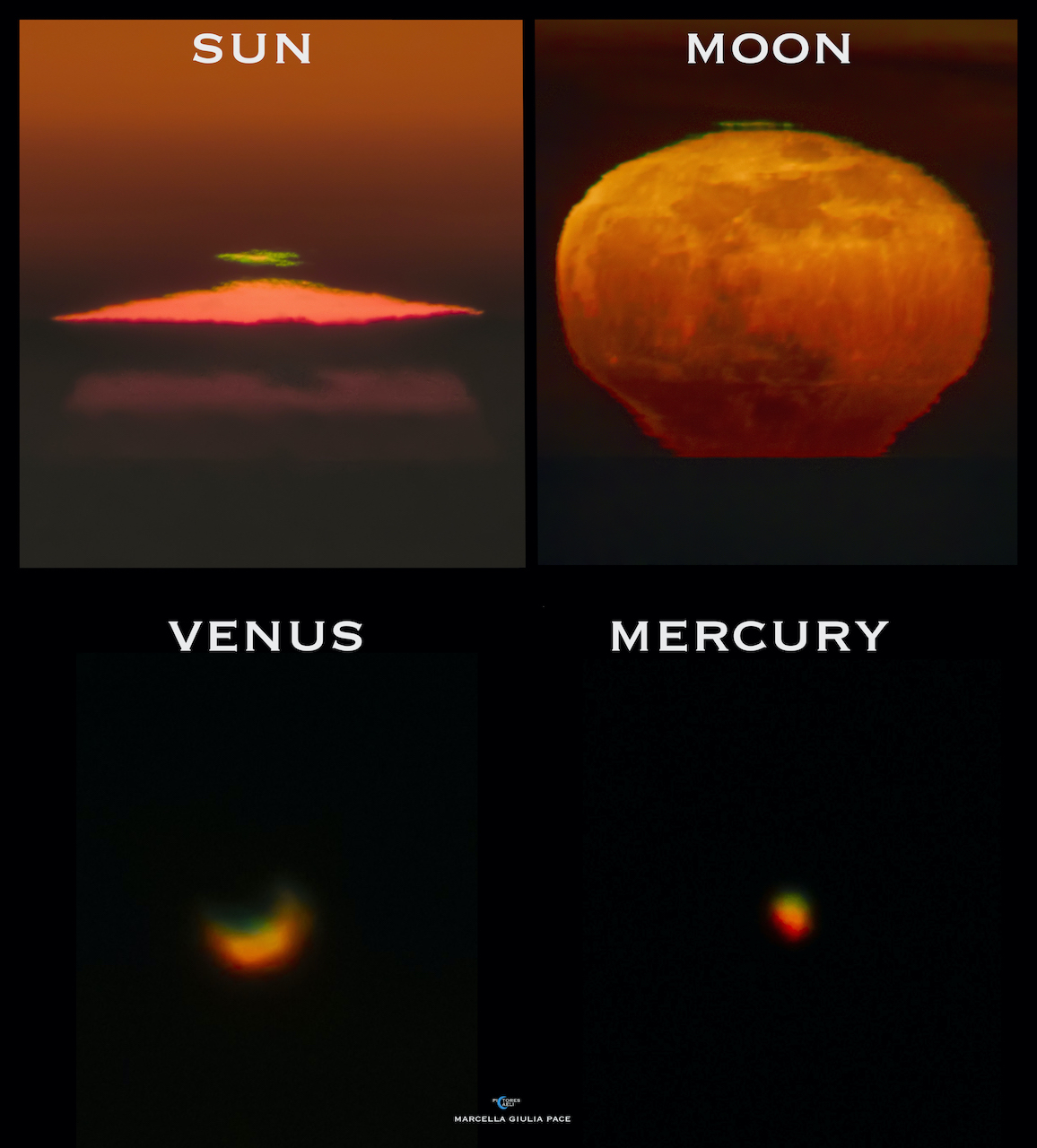
Follow a sunset on a clear day against a distant horizon and you might glimpse green just as the Sun disappears from view. The green flash is caused by refraction of light rays traveling to the eye over a long path through the atmosphere. Shorter wavelengths refract more strongly than longer redder wavelengths and the separation of colors lends a green hue to the last visible vestige of the solar disk. It's harder to see a green flash from the Moon, not to mention the diminutive disks of Venus and Mercury. But a telescope or telephoto lens and camera can help catch this tantalizing result of atmospheric refraction when the celestial bodies are near the horizon. From Sicily, the top panels were recorded on March 18, 2019 for the Sun and May 8, 2020 for the Moon. Also from the Mediterranean island, the bottom panels were shot during the twilight apparition of Venus and Mercury near the western horizon on May 24.