The Sun
The Sun is a yellow dwarf star (G2V), about 4.6 billion years old, and the dominant gravitational force in the Solar System. It has a diameter of roughly 1.4 million kilometers and contains around 99.8% of the Solar System’s mass. Nuclear fusion in its core converts hydrogen into helium, producing energy that warms the planets. Above the core lie the radiative and convective zones, followed by the visible photosphere (~5,500 °C), the chromosphere, and the much hotter corona (~2 million °C).
Source: science.nasa.gov
APODs including "The Sun"
Eclipse under the ISS
27/06/2020
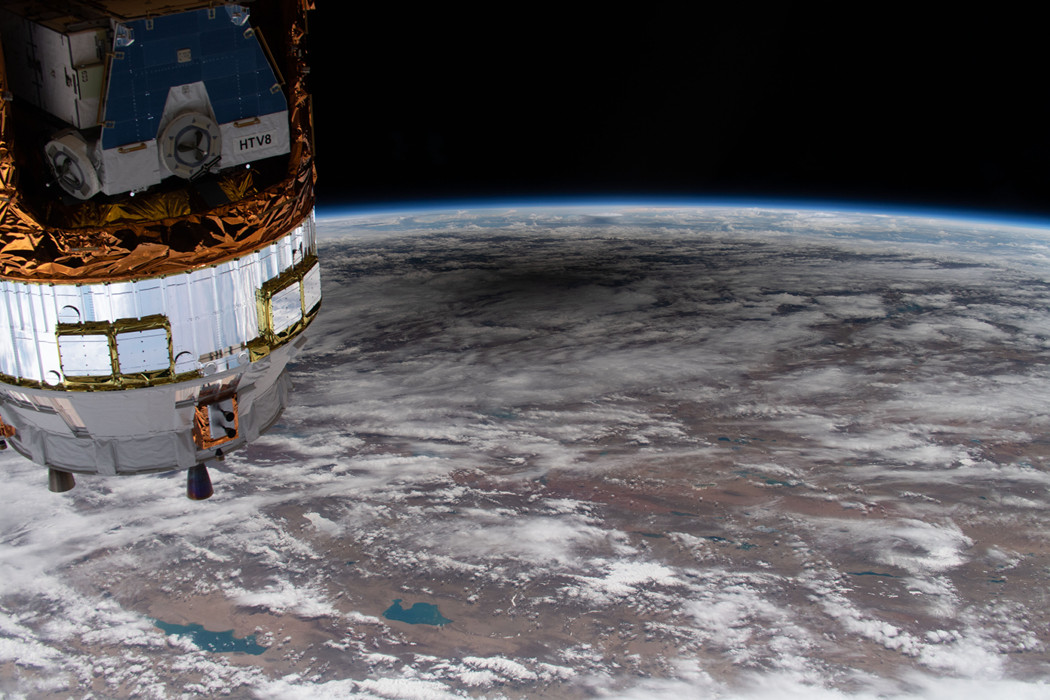
The dark shadow of the New Moon reached out and touched planet Earth on June 21. A high definition camera outside the International Space Station captured its passing in this snapshot from low Earth orbit near the border of Kazakhstan and China. Of course those along the Moon's central shadow track below could watch the much anticipated annular eclipse of the Sun. In the foreground a cargo spacecraft is docked with the orbital outpost. It's the H-II Transfer Vehicle-9 from JAXA the Japan Aerospace Exploration Agency. Gallery: Notable images of the Annular Solar Eclipse of 2020 June submitted to APOD