The Sun
The Sun is a yellow dwarf star (G2V), about 4.6 billion years old, and the dominant gravitational force in the Solar System. It has a diameter of roughly 1.4 million kilometers and contains around 99.8% of the Solar System’s mass. Nuclear fusion in its core converts hydrogen into helium, producing energy that warms the planets. Above the core lie the radiative and convective zones, followed by the visible photosphere (~5,500 °C), the chromosphere, and the much hotter corona (~2 million °C).
Source: science.nasa.gov
APODs including "The Sun"
Meeting in the Mesosphere
04/07/2020
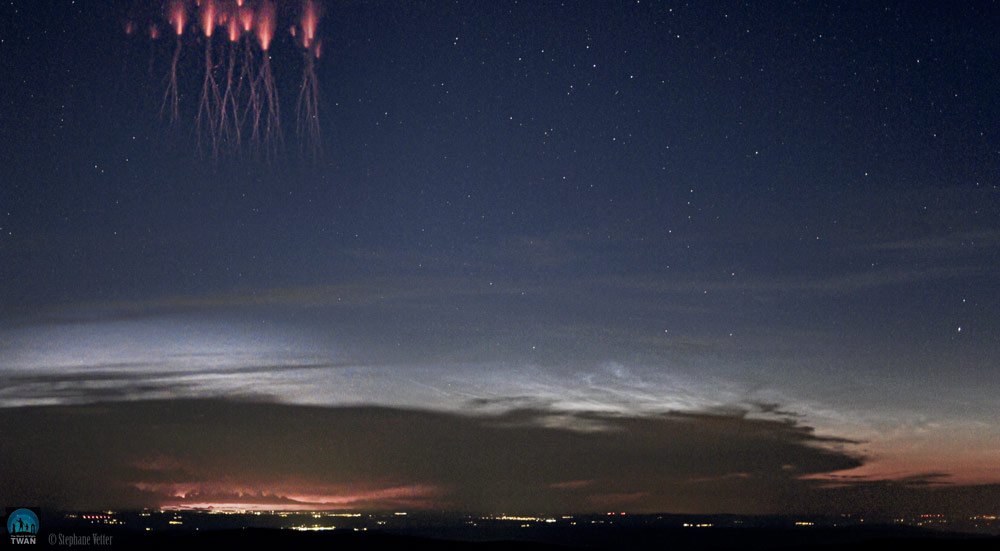
A sensitive video camera on a summit of the Vosges mountains in France captured these surprising fireworks above a distant horizon on June 26. Generated over intense thunderstorms, this one about 260 kilometers away, the brief and mysterious flashes have come to be known as red sprites. The transient luminous events are caused by electrical breakdown at altitudes of 50 to 100 kilometers. That puts them in the mesophere, the coldest layer of planet Earth's atmosphere. The glow beneath the sprites is from more familiar lighting though, below the storm clouds. But on the right, the video frames have captured another summertime apparition from the mesophere. The silvery veins of light are polar mesospheric clouds. Also known as noctilucent or night shining clouds, the icy clouds still reflect the sunlight when the Sun is below the horizon.