The Sun
The Sun is a yellow dwarf star (G2V), about 4.6 billion years old, and the dominant gravitational force in the Solar System. It has a diameter of roughly 1.4 million kilometers and contains around 99.8% of the Solar System’s mass. Nuclear fusion in its core converts hydrogen into helium, producing energy that warms the planets. Above the core lie the radiative and convective zones, followed by the visible photosphere (~5,500 °C), the chromosphere, and the much hotter corona (~2 million °C).
Source: science.nasa.gov
APODs including "The Sun"
Comet NEOWISE over Lebanon
07/07/2020
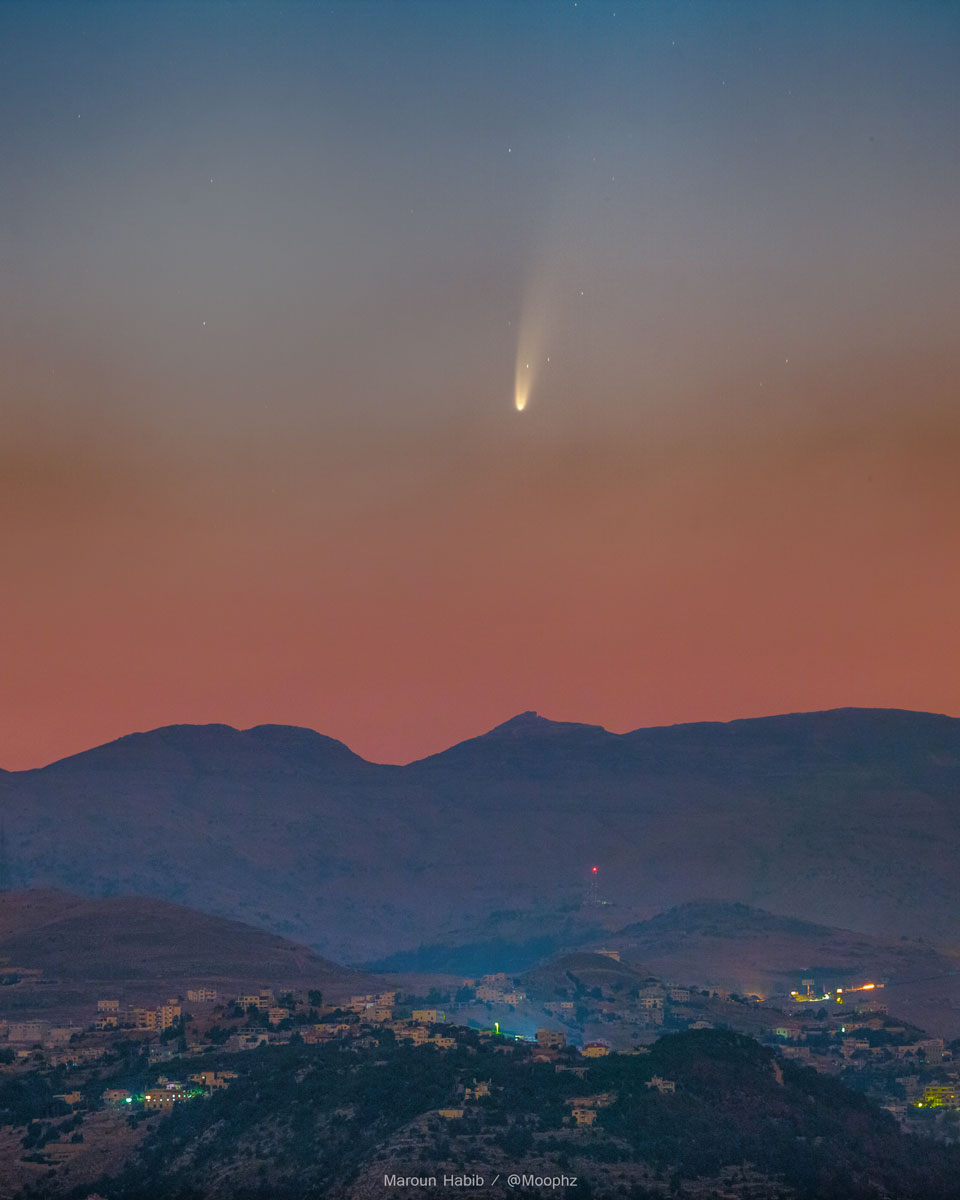
A comet has suddenly become visible to the unaided eye. Comet C/2020 F3 (NEOWISE) was discovered in late March and brightened as it reached its closest approach to the Sun, inside the orbit of Mercury, late last week. The interplanetary iceberg survived solar heating, so far, and is now becoming closer to the Earth as it starts its long trek back to the outer Solar System. As Comet NEOWISE became one of the few naked-eye comets of the 21st Century, word spread quickly, and the comet has already been photographed behind many famous sites and cities around the globe. Featured, Comet NEOWISE was captured over Lebanon two days ago just before sunrise. The future brightness of Comet NEOWISE remains somewhat uncertain but the comet will likely continue to be findable not only in the early morning sky, but also next week in the early evening sky. Comet NEOWISE from Around the Globe: Notable Images Submitted to APOD