The Sun
The Sun is a yellow dwarf star (G2V), about 4.6 billion years old, and the dominant gravitational force in the Solar System. It has a diameter of roughly 1.4 million kilometers and contains around 99.8% of the Solar System’s mass. Nuclear fusion in its core converts hydrogen into helium, producing energy that warms the planets. Above the core lie the radiative and convective zones, followed by the visible photosphere (~5,500 °C), the chromosphere, and the much hotter corona (~2 million °C).
Source: science.nasa.gov
APODs including "The Sun"
Comet NEOWISE from the ISS
10/07/2020
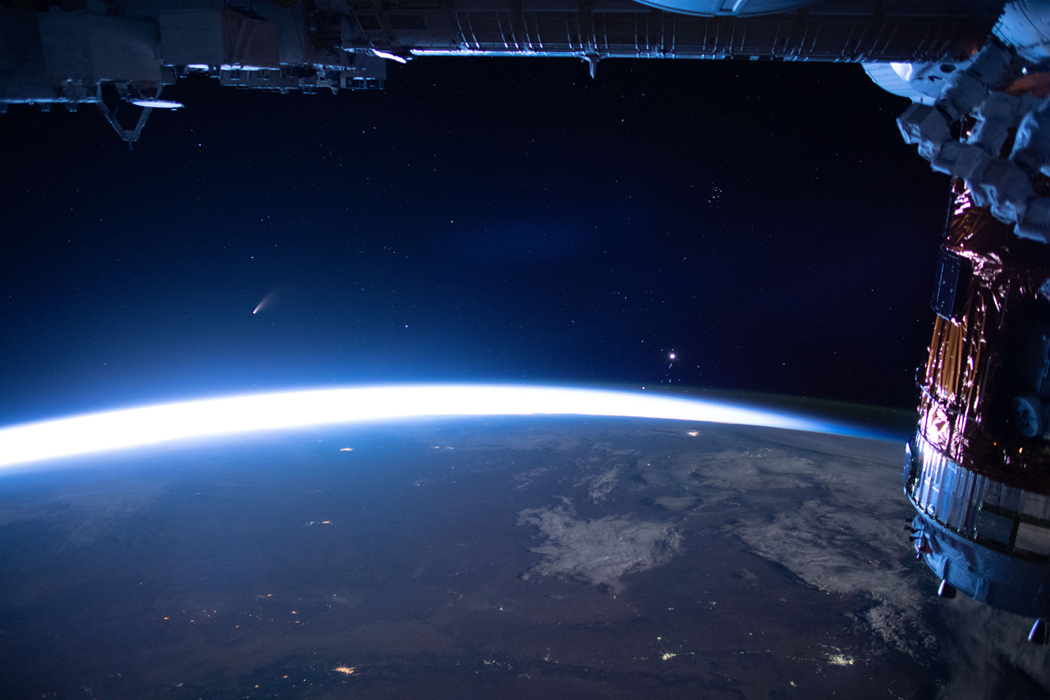
Rounding the Sun on July 3rd and currently headed for the outer Solar System, Comet NEOWISE (C/2020 F3) has been growing brighter in the predawn skies of planet Earth. From low Earth orbit it also rises before the Sun, captured above the approaching glow along the eastern horizon in this snapshot from the International Space Station on July 5. Venus, now Earth's morning star is the brilliant celestial beacon on the right in the field of view. Above Venus you can spot the sister stars of the more compact Pleiades cluster. Earthbound skygazers can spot this comet with the unaided eye, but should look for awesome views with binoculars. Comet NEOWISE from Earth's Surface: Notable Images Submitted to APOD