The Sun
The Sun is a yellow dwarf star (G2V), about 4.6 billion years old, and the dominant gravitational force in the Solar System. It has a diameter of roughly 1.4 million kilometers and contains around 99.8% of the Solar System’s mass. Nuclear fusion in its core converts hydrogen into helium, producing energy that warms the planets. Above the core lie the radiative and convective zones, followed by the visible photosphere (~5,500 °C), the chromosphere, and the much hotter corona (~2 million °C).
Source: science.nasa.gov
APODs including "The Sun"
The Tails of Comet NEOWISE
11/07/2020
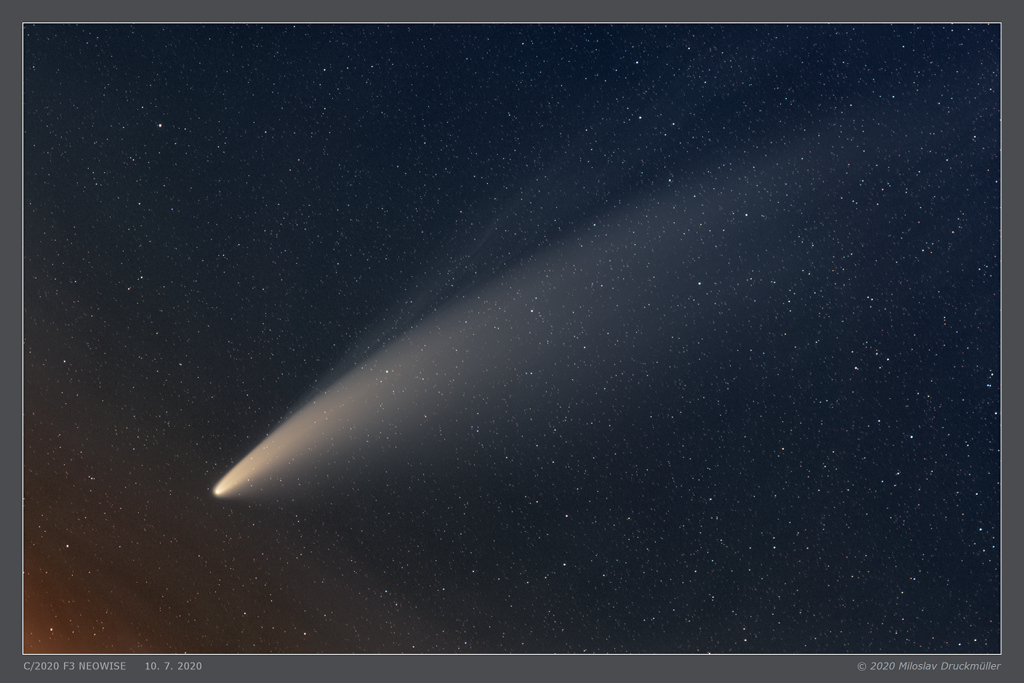
Comet NEOWISE (C/2020 F3) is now sweeping through northern skies. Its developing tails stretch some six degrees across this telescopic field of view, recorded from Brno, Czech Republic before daybreak on July 10. Pushed out by the pressure of sunlight itself, the comet's broad, yellowish dust tail is easiest to see. But the image also captures a fainter, more bluish tail too, separate from the reflective comet dust. The fainter tail is an ion tail, formed as ions from the cometary coma are dragged outward by magnetic fields in the solar wind and fluoresce in the sunlight. In this sharp portrait of our new visitor from the outer Solar System, the tails of comet NEOWISE are reminiscent of the even brighter tails of Hale Bopp, the Great Comet of 1997. Comet NEOWISE from Around the Globe: Notable Images Submitted to APOD