The Sun
The Sun is a yellow dwarf star (G2V), about 4.6 billion years old, and the dominant gravitational force in the Solar System. It has a diameter of roughly 1.4 million kilometers and contains around 99.8% of the Solar System’s mass. Nuclear fusion in its core converts hydrogen into helium, producing energy that warms the planets. Above the core lie the radiative and convective zones, followed by the visible photosphere (~5,500 °C), the chromosphere, and the much hotter corona (~2 million °C).
Source: science.nasa.gov
APODs including "The Sun"
The Giants of Summer
29/07/2020
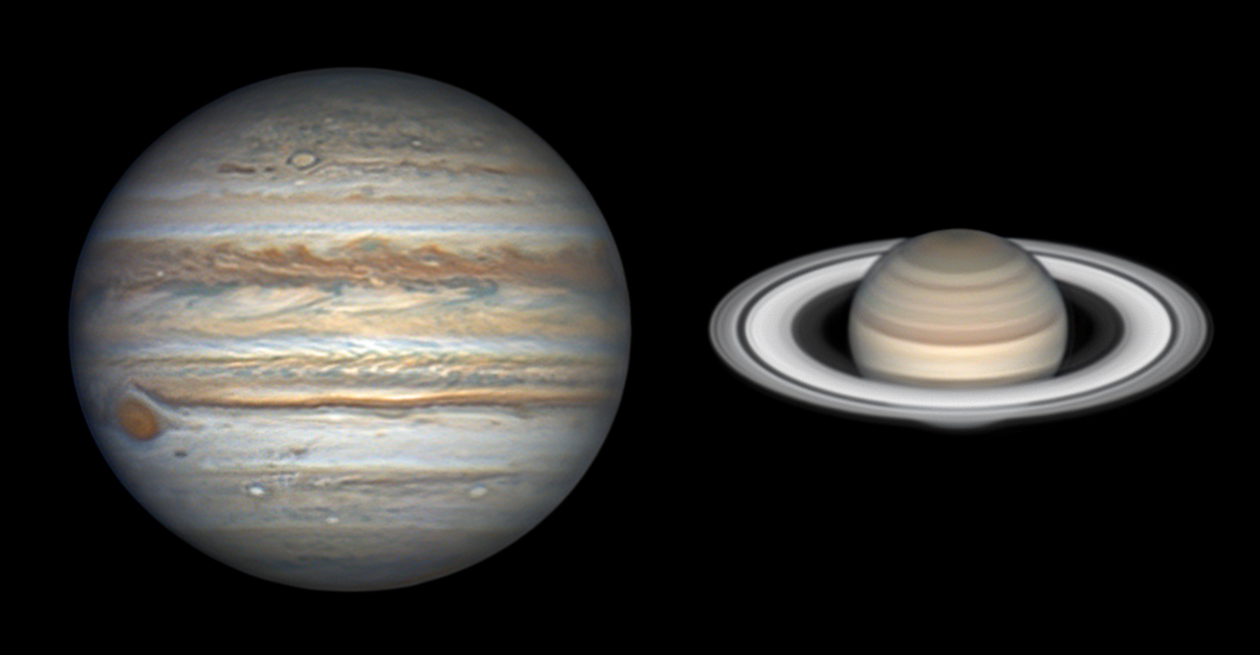
As Comet NEOWISE sweeps through northern summer skies, Jupiter and Saturn are shining brightly, near opposition. With Jupiter opposite the Sun on July 14 and Saturn on July 21, the giant planets are still near their closest to planet Earth in 2020. Sharing the constellation Sagittarius they are up all night, and offer their best and brightest views at the telescope. Both captured on July 22 from a balcony in Paris these two sharp telescopic images don't disappoint, showing off what the giant planets are famous for, Saturn's bright rings and Jupiter's Great Red Spot. These giants of the Solar System are worth following during 2020. On December 21, skygazers can watch the once-in-20-year great conjunction of Jupiter and Saturn. Comet NEOWISE images from planet Earth: July 28, 27, 26, 25, 24