The Sun
The Sun is a yellow dwarf star (G2V), about 4.6 billion years old, and the dominant gravitational force in the Solar System. It has a diameter of roughly 1.4 million kilometers and contains around 99.8% of the Solar System’s mass. Nuclear fusion in its core converts hydrogen into helium, producing energy that warms the planets. Above the core lie the radiative and convective zones, followed by the visible photosphere (~5,500 °C), the chromosphere, and the much hotter corona (~2 million °C).
Source: science.nasa.gov
APODs including "The Sun"
Martian Chiaroscuro
29/08/2020
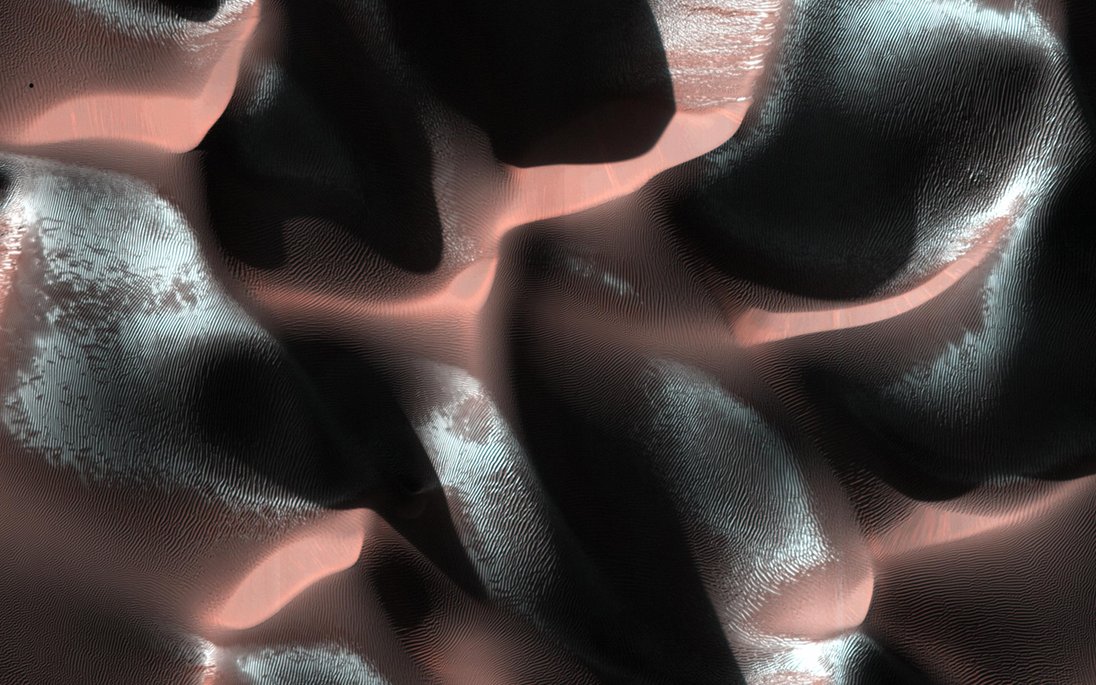
Deep shadows create dramatic contrasts between light and dark in this high-resolution close-up of the martian surface. Recorded on January 24, 2014 by the HiRISE camera on board the Mars Reconnaissance Orbiter, the scene spans about 1.5 kilometers. From 250 kilometers above the Red Planet the camera is looking down at a sand dune field in a southern highlands crater. Captured when the Sun was about 5 degrees above the local horizon, only the dune crests were caught in full sunlight. A long, cold winter was coming to the southern hemisphere and bright ridges of seasonal frost line the martian dunes. The Mars Reconnaissance Orbiter, one of the oldest operating spacecraft at the Red Planet, celebrated the 15th anniversary of its launch from planet Earth on August 12.