The Sun
The Sun is a yellow dwarf star (G2V), about 4.6 billion years old, and the dominant gravitational force in the Solar System. It has a diameter of roughly 1.4 million kilometers and contains around 99.8% of the Solar System’s mass. Nuclear fusion in its core converts hydrogen into helium, producing energy that warms the planets. Above the core lie the radiative and convective zones, followed by the visible photosphere (~5,500 °C), the chromosphere, and the much hotter corona (~2 million °C).
Source: science.nasa.gov
APODs including "The Sun"
The Milky Way over St Michael's Mount
07/09/2020
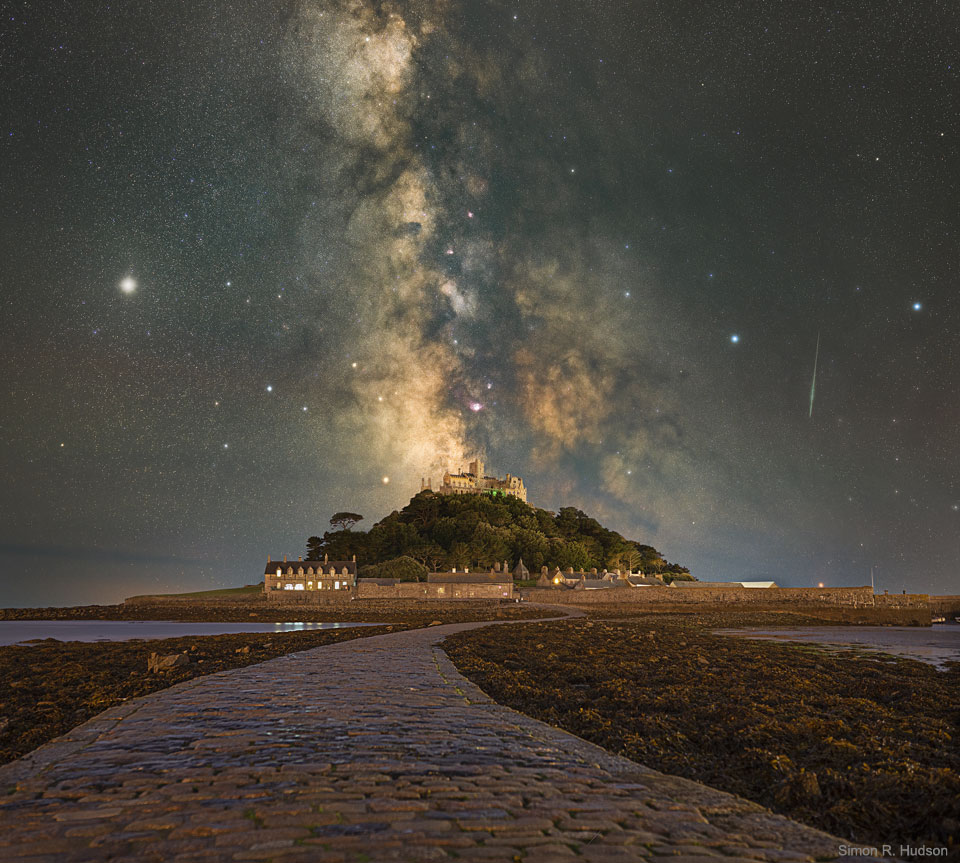
Where do land and sky converge? On every horizon -- but in this case the path on the ground leads to St Michael's Mount (Cornish: Karrek Loos yn Koos), a small historic island in Cornwall, England. The Mount is usually surrounded by shallow water, but at low tide is spanned by a human-constructed causeway. The path on the sky, actually the central band of our Milky Way Galaxy, also appears to lead to St Michael's Mount, but really lies far in the distance. The red nebula in the Milky Way, just above the castle, is the Lagoon Nebula, while bright Jupiter shines to the left, and a luminous meteor flashes to the right. The foreground and background images of this featured composite were taken on the same July night and from the same location. Although meteors are fleeting and the Milky Way disk shifts in the night as the Earth turns, Jupiter will remain prominent in the sunset sky into December. Moon Occults Mars: Notable images submitted to APOD