The Sun
The Sun is a yellow dwarf star (G2V), about 4.6 billion years old, and the dominant gravitational force in the Solar System. It has a diameter of roughly 1.4 million kilometers and contains around 99.8% of the Solar System’s mass. Nuclear fusion in its core converts hydrogen into helium, producing energy that warms the planets. Above the core lie the radiative and convective zones, followed by the visible photosphere (~5,500 °C), the chromosphere, and the much hotter corona (~2 million °C).
Source: science.nasa.gov
APODs including "The Sun"
Mars Approach 2020
06/10/2020
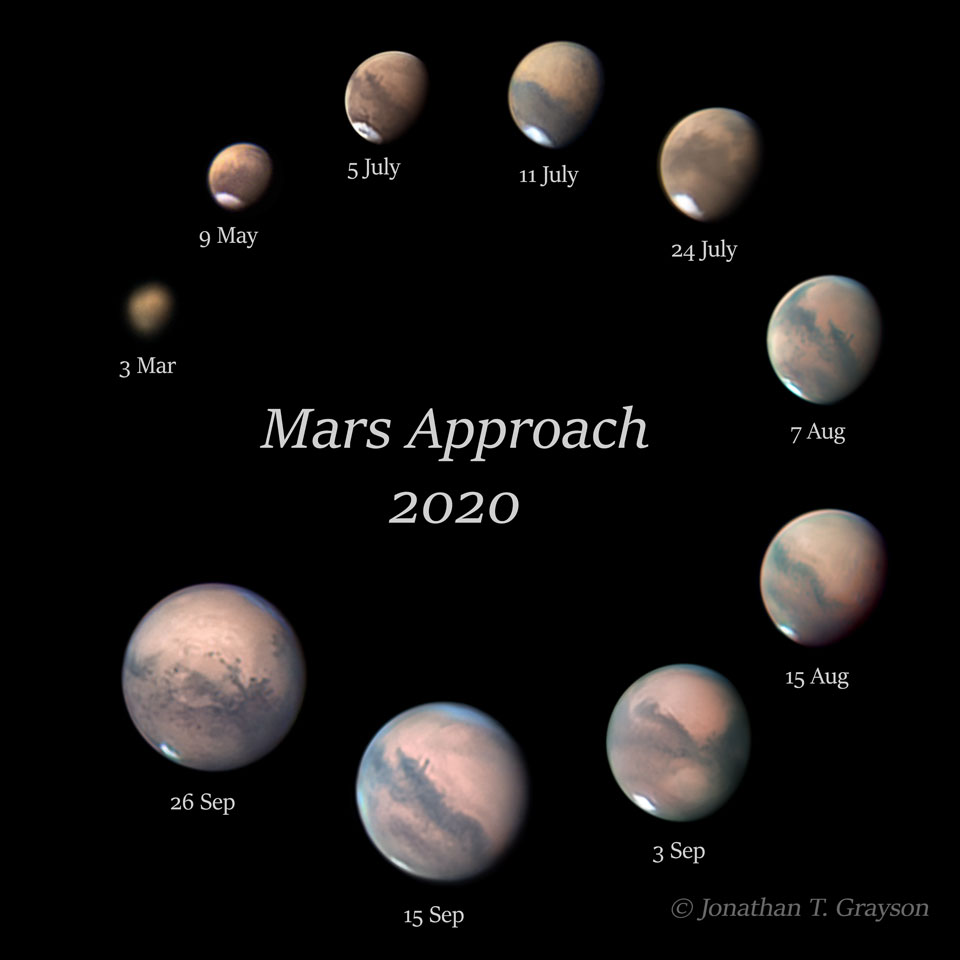
Look to the east just after sunset tonight and you'll see a most impressive Mars. Tonight, Mars will appear its biggest and brightest of the year, as Earth passes closer to the red planet than it has in over two years -- and will be again for another two years. In a week, Mars will be almost as bright -- but at opposition, meaning that it will be directly opposite the Sun. Due to the slightly oval shape of the orbits of Mars and Earth, closest approach and opposition occur on slightly different days. The featured image sequence shows how the angular size of Mars has grown during its approach over the past few months. Noticeably orange, Mars is now visible nearly all night long, reflecting more sunlight toward Earth than either Saturn or Jupiter. Even at its closest and largest, though, Mars will still appear about 100 times smaller, in diameter, than a full moon.