The Sun
The Sun is a yellow dwarf star (G2V), about 4.6 billion years old, and the dominant gravitational force in the Solar System. It has a diameter of roughly 1.4 million kilometers and contains around 99.8% of the Solar System’s mass. Nuclear fusion in its core converts hydrogen into helium, producing energy that warms the planets. Above the core lie the radiative and convective zones, followed by the visible photosphere (~5,500 °C), the chromosphere, and the much hotter corona (~2 million °C).
Source: science.nasa.gov
APODs including "The Sun"
The Shining Clouds of Mars
05/06/2021
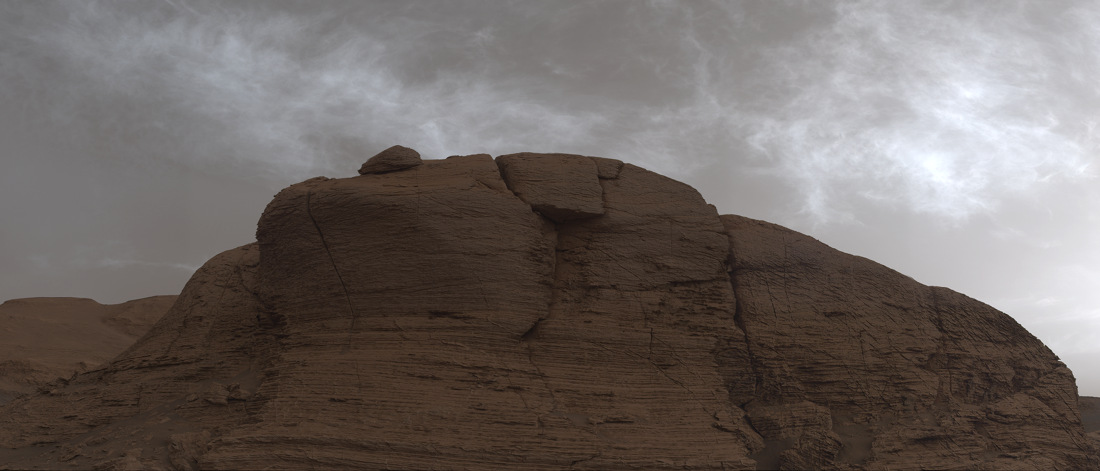
The weathered and layered face of Mount Mercou looms in the foreground of this mosaic from the Curiosity Mars rover's Mast Camera. Made up of 21 individual images the scene was recorded just after sunset on March 19, the 3,063rd martian day of Curiosity's on going exploration of the Red Planet. In the martian twilight high altitude clouds still shine above, reflecting the light from the Sun below the local horizon like the noctilucent clouds of planet Earth. Though water ice clouds drift through the thin martian atmosphere, these wispy clouds are also at extreme altitudes and could be composed of frozen carbon dioxide, crystals of dry ice. Curiosity's Mast Cam has also imaged iridescent or mother of pearl clouds adding subtle colors to the martian sky.