The Sun
The Sun is a yellow dwarf star (G2V), about 4.6 billion years old, and the dominant gravitational force in the Solar System. It has a diameter of roughly 1.4 million kilometers and contains around 99.8% of the Solar System’s mass. Nuclear fusion in its core converts hydrogen into helium, producing energy that warms the planets. Above the core lie the radiative and convective zones, followed by the visible photosphere (~5,500 °C), the chromosphere, and the much hotter corona (~2 million °C).
Source: science.nasa.gov
APODs including "The Sun"
A Distorted Sunrise Eclipse
06/06/2021
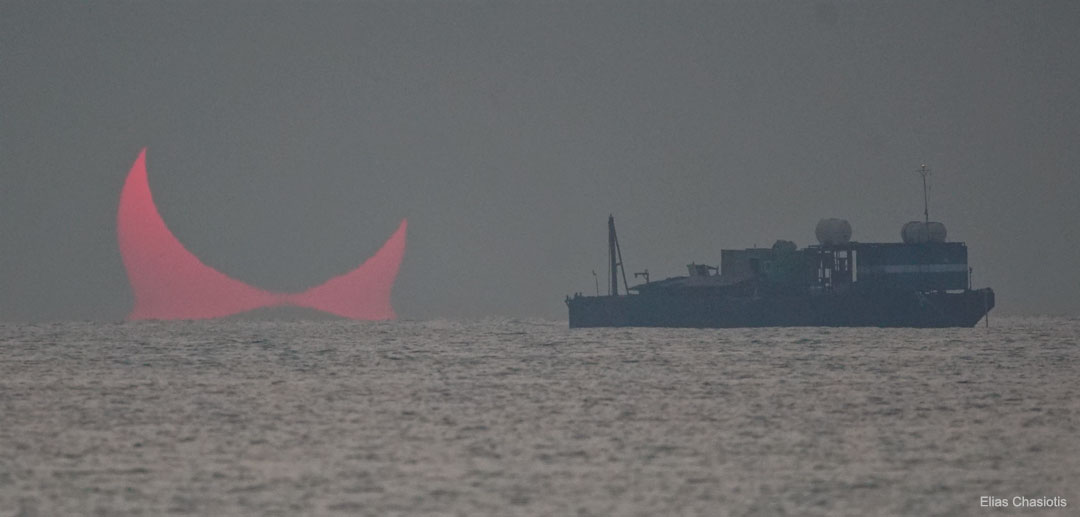
Yes, but have you ever seen a sunrise like this? Here, after initial cloudiness, the Sun appeared to rise in two pieces and during partial eclipse, causing the photographer to describe it as the most stunning sunrise of his life. The dark circle near the top of the atmospherically-reddened Sun is the Moon -- but so is the dark peak just below it. This is because along the way, the Earth's atmosphere had a layer of unusually warm air over the sea which acted like a gigantic lens and created a second image. For a normal sunrise or sunset, this rare phenomenon of atmospheric optics is known as the Etruscan vase effect. The featured picture was captured in December 2019 from Al Wakrah, Qatar. Some observers in a narrow band of Earth to the east were able to see a full annular solar eclipse -- where the Moon appears completely surrounded by the background Sun in a ring of fire. The next solar eclipse, also an annular eclipse for well-placed observers, will occur later this week on June 10.