The Sun
The Sun is a yellow dwarf star (G2V), about 4.6 billion years old, and the dominant gravitational force in the Solar System. It has a diameter of roughly 1.4 million kilometers and contains around 99.8% of the Solar System’s mass. Nuclear fusion in its core converts hydrogen into helium, producing energy that warms the planets. Above the core lie the radiative and convective zones, followed by the visible photosphere (~5,500 °C), the chromosphere, and the much hotter corona (~2 million °C).
Source: science.nasa.gov
APODs including "The Sun"
Northern Summer Twilight
19/06/2021
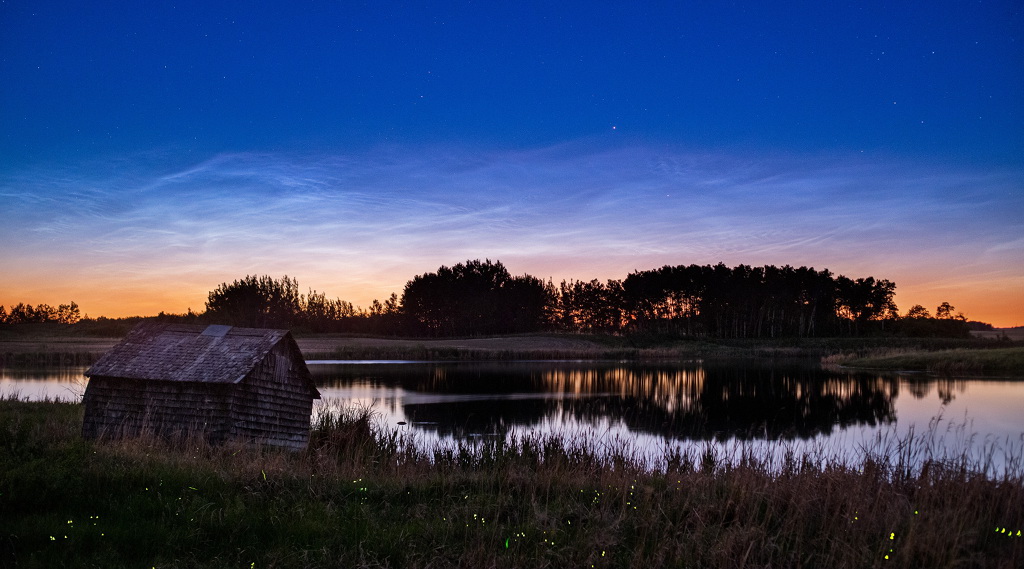
Nights grow shorter and days grow longer as the summer solstice approaches in the north. Usually seen at high latitudes in summer months, noctilucent or night shining clouds begin to make their appearance. Drifting near the edge of space about 80 kilometers above the Earth's surface, these icy clouds were still reflecting the sunlight on June 14. Though the Sun was below the horizon as seen north of Forrest, Manitoba, Canada, they were caught in a single exposure of a near midnight twilight sky. Multiple exposures of the foreground track the lower altitude flash of fireflies, another fleeting apparition shining in the summer night.