The Sun
The Sun is a yellow dwarf star (G2V), about 4.6 billion years old, and the dominant gravitational force in the Solar System. It has a diameter of roughly 1.4 million kilometers and contains around 99.8% of the Solar System’s mass. Nuclear fusion in its core converts hydrogen into helium, producing energy that warms the planets. Above the core lie the radiative and convective zones, followed by the visible photosphere (~5,500 °C), the chromosphere, and the much hotter corona (~2 million °C).
Source: science.nasa.gov
APODs including "The Sun"
A Paper Moon Solar Eclipse
28/06/2021
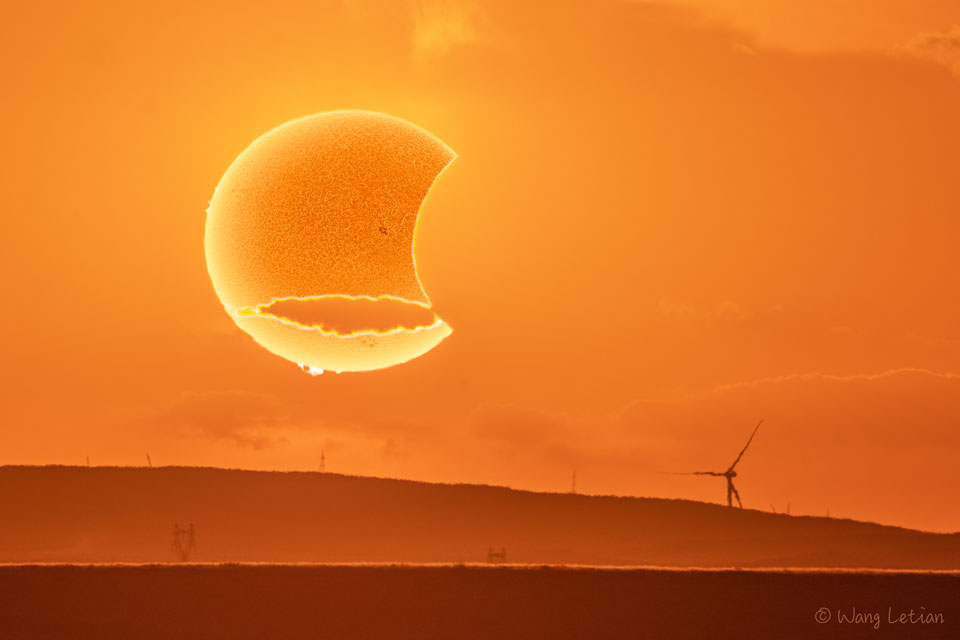
It may look like a paper Moon. Sailing past a canvas Sun. But those are not cardboard clouds. And it's not make believe. The featured picture of an orange colored sky is real -- a digital composite of two exposures of the solar eclipse that occurred earlier this month. The first exposure was taken with a regular telescope that captured an overexposed Sun and an underexposed Moon, while the second image was taken with a solar telescope that captured details of the chromosphere of the background Sun. The Sun's canvas-like texture was brought up by imaging in a very specific shade of red emitted by hydrogen. Several prominences can be seen around the Sun's edge. The image was captured just before sunset from Xilingol, Inner Mongolia, China. It's also not make-believe to imagine that the Moon is made of dense rock, the Sun is made of hot gas, and clouds are made of floating droplets of water and ice.