The Sun
The Sun is a yellow dwarf star (G2V), about 4.6 billion years old, and the dominant gravitational force in the Solar System. It has a diameter of roughly 1.4 million kilometers and contains around 99.8% of the Solar System’s mass. Nuclear fusion in its core converts hydrogen into helium, producing energy that warms the planets. Above the core lie the radiative and convective zones, followed by the visible photosphere (~5,500 °C), the chromosphere, and the much hotter corona (~2 million °C).
Source: science.nasa.gov
APODs including "The Sun"
AR2835: Islands in the Photosphere
02/07/2021
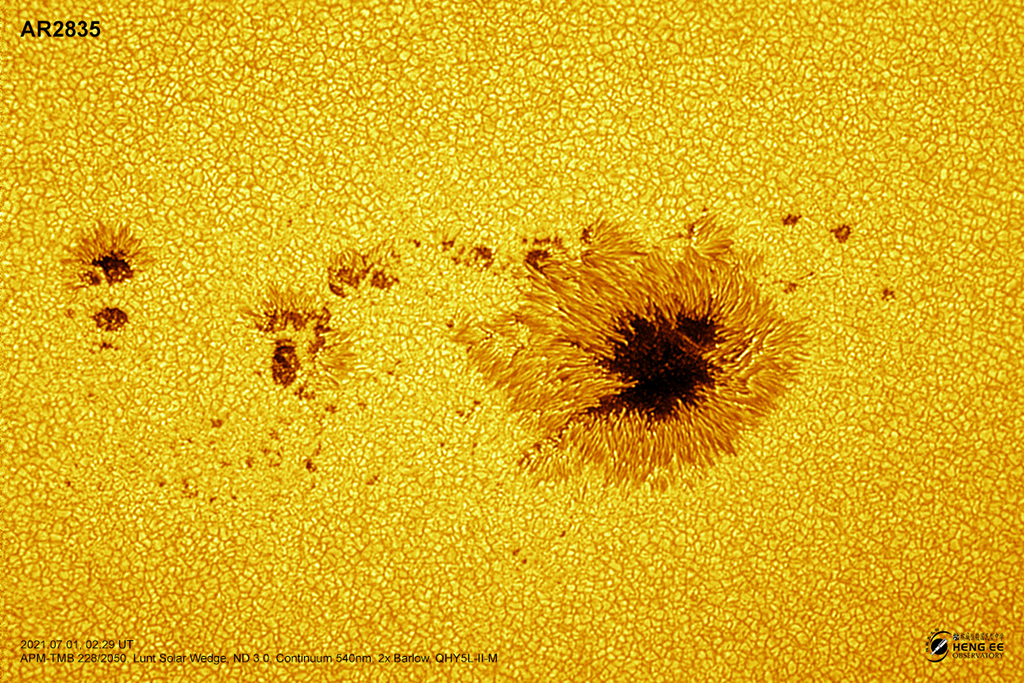
Awash in a sea of incandescent plasma and anchored in strong magnetic fields, sunspots are planet-sized dark islands in the solar photosphere, the bright surface of the Sun. Found in solar active regions, sunspots look dark only because they are slightly cooler though, with temperatures of about 4,000 kelvins compared to 6,000 kelvins for the surrounding solar surface. These sunspots lie in active region AR2835. The largest active region now crossing the Sun, AR2835 is captured in this sharp telescopic close-up from July 1 in a field of view that spans about 150,000 kilometers or over ten Earth diameters. With powerful magnetic fields, solar active regions are often responsible for solar flares and coronal mass ejections, storms which affect space weather near planet Earth.