The Sun
The Sun is a yellow dwarf star (G2V), about 4.6 billion years old, and the dominant gravitational force in the Solar System. It has a diameter of roughly 1.4 million kilometers and contains around 99.8% of the Solar System’s mass. Nuclear fusion in its core converts hydrogen into helium, producing energy that warms the planets. Above the core lie the radiative and convective zones, followed by the visible photosphere (~5,500 °C), the chromosphere, and the much hotter corona (~2 million °C).
Source: science.nasa.gov
APODs including "The Sun"
A Blue Hour Full Moon
26/08/2021
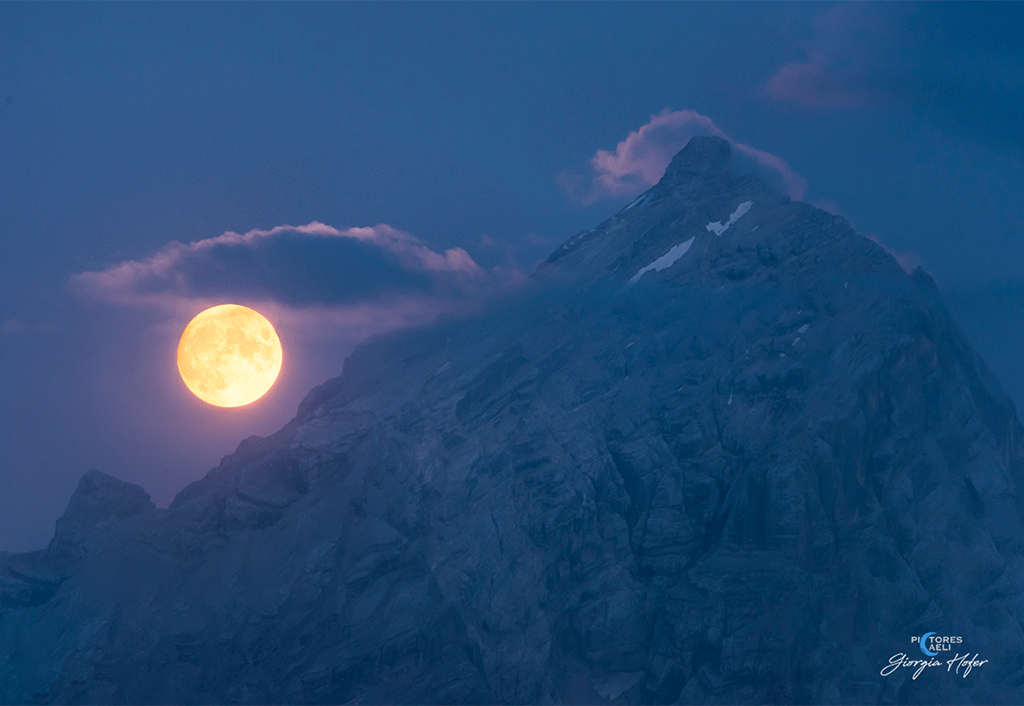
Nature photographers and other fans of planet Earth always look forward to the blue hour. That's the transition in twilight, just before sunrise or after sunset, when the Sun is below the horizon but land and sky are still suffused with a beautiful blue light. After sunset on August 21, this blue hour snapshot captured the nearly full Moon as it rose opposite the Sun, above the rugged Italian Alps from Cortina d'Ampezzo, Italy. Sharing bluish hues with the sky, the rocky pyramid of Monte Antelao, also known as the King of the Dolomites, is the region's prominent alpine peak. The moonlight is yellow, but even so this full Moon was known to some as a seasonal Blue Moon. That's because by one definition the third full Moon of a season with four full moons in it is called a Blue Moon. Recognizing a season as the time between a solstice and an equinox, this season's fourth full Moon will be rising in the blue hour of September 20, just before September's equinox.