The Sun
The Sun is a yellow dwarf star (G2V), about 4.6 billion years old, and the dominant gravitational force in the Solar System. It has a diameter of roughly 1.4 million kilometers and contains around 99.8% of the Solar System’s mass. Nuclear fusion in its core converts hydrogen into helium, producing energy that warms the planets. Above the core lie the radiative and convective zones, followed by the visible photosphere (~5,500 °C), the chromosphere, and the much hotter corona (~2 million °C).
Source: science.nasa.gov
APODs including "The Sun"
Rings and Seasons of Saturn
19/09/2021
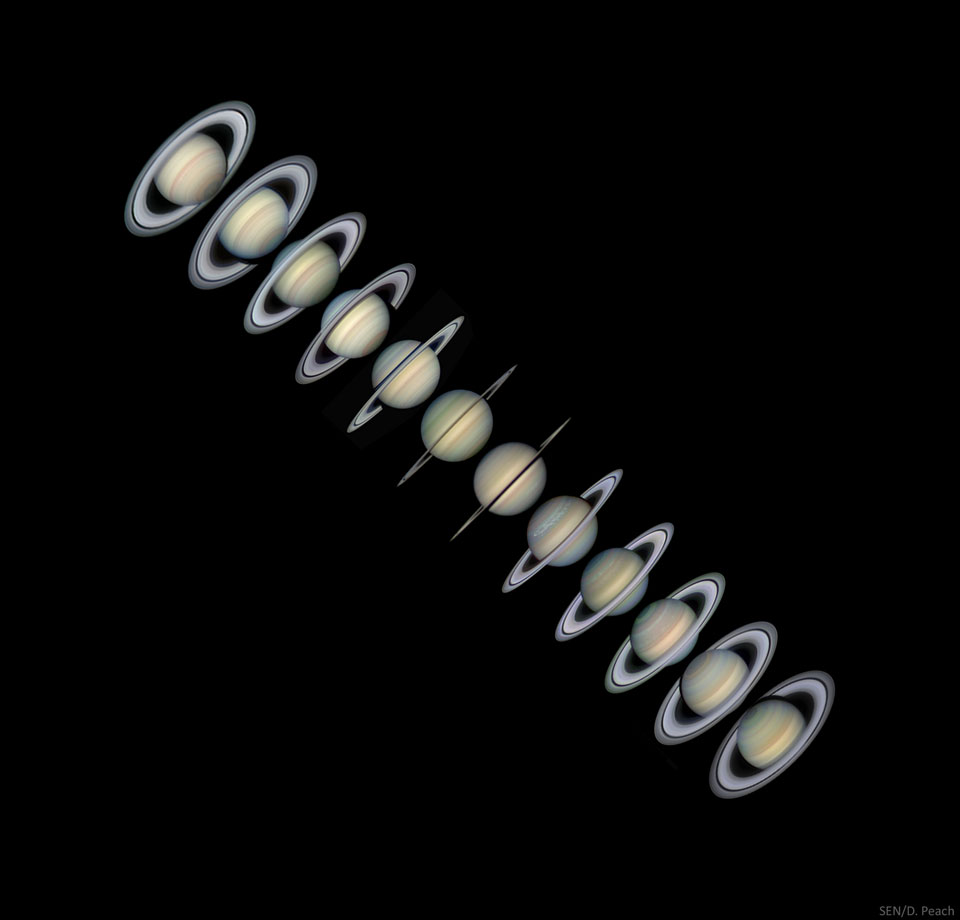
On Saturn, the rings tell you the season. On Earth, Wednesday marks an equinox, the time when the Earth's equator tilts directly toward the Sun. Since Saturn's grand rings orbit along the planet's equator, these rings appear most prominent -- from the direction of the Sun -- when the spin axis of Saturn points toward the Sun. Conversely, when Saturn's spin axis points to the side, an equinox occurs and the edge-on rings are hard to see from not only the Sun -- but Earth. In the featured montage, images of Saturn between the years of 2004 and 2015 have been superposed to show the giant planet passing from southern summer toward northern summer. Saturn was as close as it can get to planet Earth last month, and this month the ringed giant is still bright and visible throughout much of the night