The Sun
The Sun is a yellow dwarf star (G2V), about 4.6 billion years old, and the dominant gravitational force in the Solar System. It has a diameter of roughly 1.4 million kilometers and contains around 99.8% of the Solar System’s mass. Nuclear fusion in its core converts hydrogen into helium, producing energy that warms the planets. Above the core lie the radiative and convective zones, followed by the visible photosphere (~5,500 °C), the chromosphere, and the much hotter corona (~2 million °C).
Source: science.nasa.gov
APODs including "The Sun"
Sun Spot Hill
21/09/2021
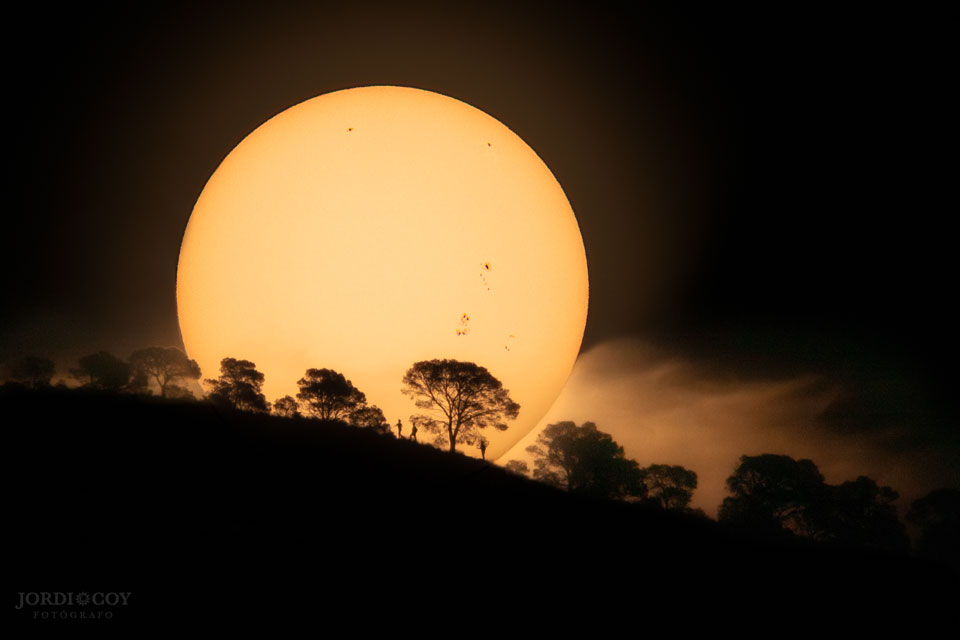
Is this giant orange ball about to roll down that tree-lined hill? No, because the giant orange ball is actually the Sun. Our Solar System's central star was captured rising beyond a hill on Earth twelve days ago complete with a delightfully detailed foreground. The Sun's disk showed five sunspots, quite a lot considering that during the solar minimum in solar activity of the past few years, most days showed no spots. A close look at the hill -- Sierra del Cid in Perter, Spain -- reveals not only silhouetted pine trees, but silhouetted people -- by coincidence three brothers of the photographer. The trees and brothers were about 3.5-kilometers away during the morning of the well-planned image. A dark filter muted the usually brilliant Sun and brought up great detail on the lower sunspots. Within a few minutes, the Sun rose far above the hill, while within a week, the sunspots rotated around the Sun, out of view. The captured scene, however, is now frozen in time for all to enjoy.