The Sun
The Sun is a yellow dwarf star (G2V), about 4.6 billion years old, and the dominant gravitational force in the Solar System. It has a diameter of roughly 1.4 million kilometers and contains around 99.8% of the Solar System’s mass. Nuclear fusion in its core converts hydrogen into helium, producing energy that warms the planets. Above the core lie the radiative and convective zones, followed by the visible photosphere (~5,500 °C), the chromosphere, and the much hotter corona (~2 million °C).
Source: science.nasa.gov
APODs including "The Sun"
A Light and Dusty Night
02/10/2021
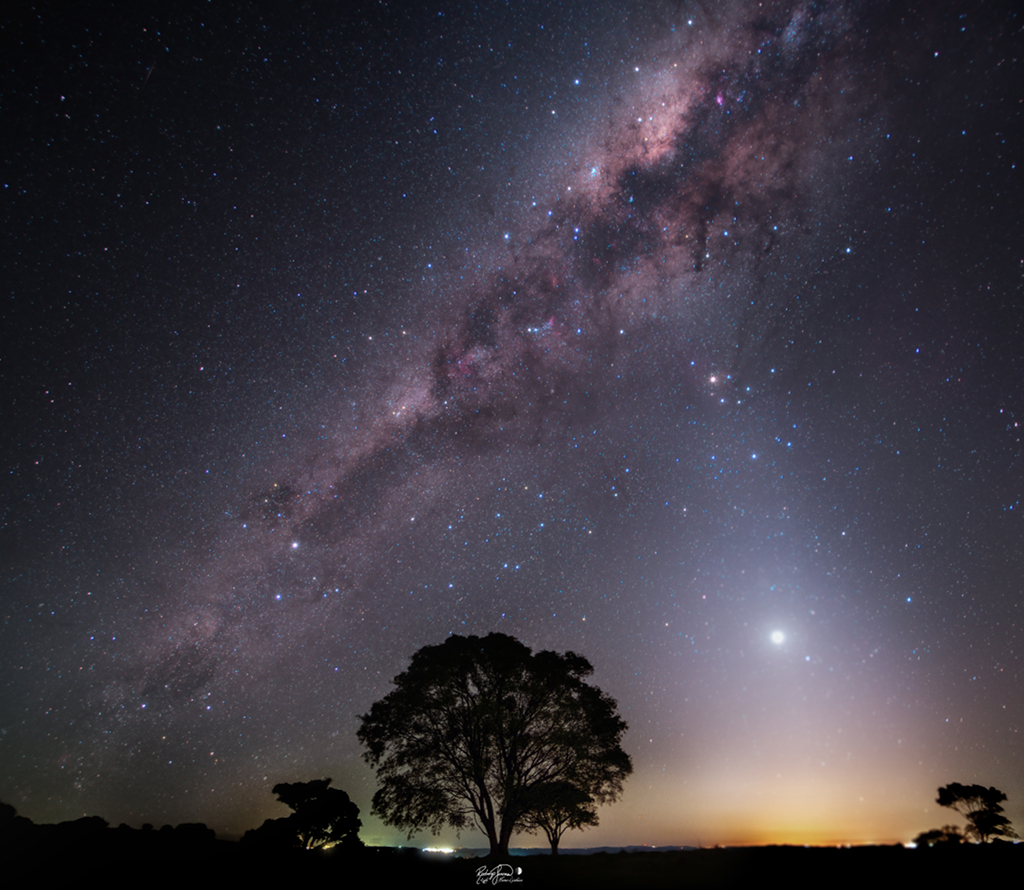
Posing as a brilliant evening star, Venus lies near the western horizon in this southern hemisphere, early spring, night skyscape. To create the composite view exposures tracking the sky and fixed for the foreground were taken on September 25 from Cascavel in southern Brazil. In view after sunset, Venus appears immersed in a cone of zodiacal light, sunlight scattered from dust along the Solar System's ecliptic plane. In fact from either hemisphere of planet Earth, zodiacal light is most visible after sunset near a spring equinox, (or before sunrise near an autumn equinox) when its luminous arc lies at steep angles to the horizon. Extending above the sunset on this night, the zodiacal light reaches toward rich starfields and immense interstellar dust clouds in the bulge of the central Milky Way. Follow along the Milky Way from the central bulge back toward the horizon and you'll spot the closest star system to the Sun, Alpha Centauri, a mere 4.37 light-years away.