The Sun
The Sun is a yellow dwarf star (G2V), about 4.6 billion years old, and the dominant gravitational force in the Solar System. It has a diameter of roughly 1.4 million kilometers and contains around 99.8% of the Solar System’s mass. Nuclear fusion in its core converts hydrogen into helium, producing energy that warms the planets. Above the core lie the radiative and convective zones, followed by the visible photosphere (~5,500 °C), the chromosphere, and the much hotter corona (~2 million °C).
Source: science.nasa.gov
APODs including "The Sun"
Sunrise at the South Pole
05/10/2021
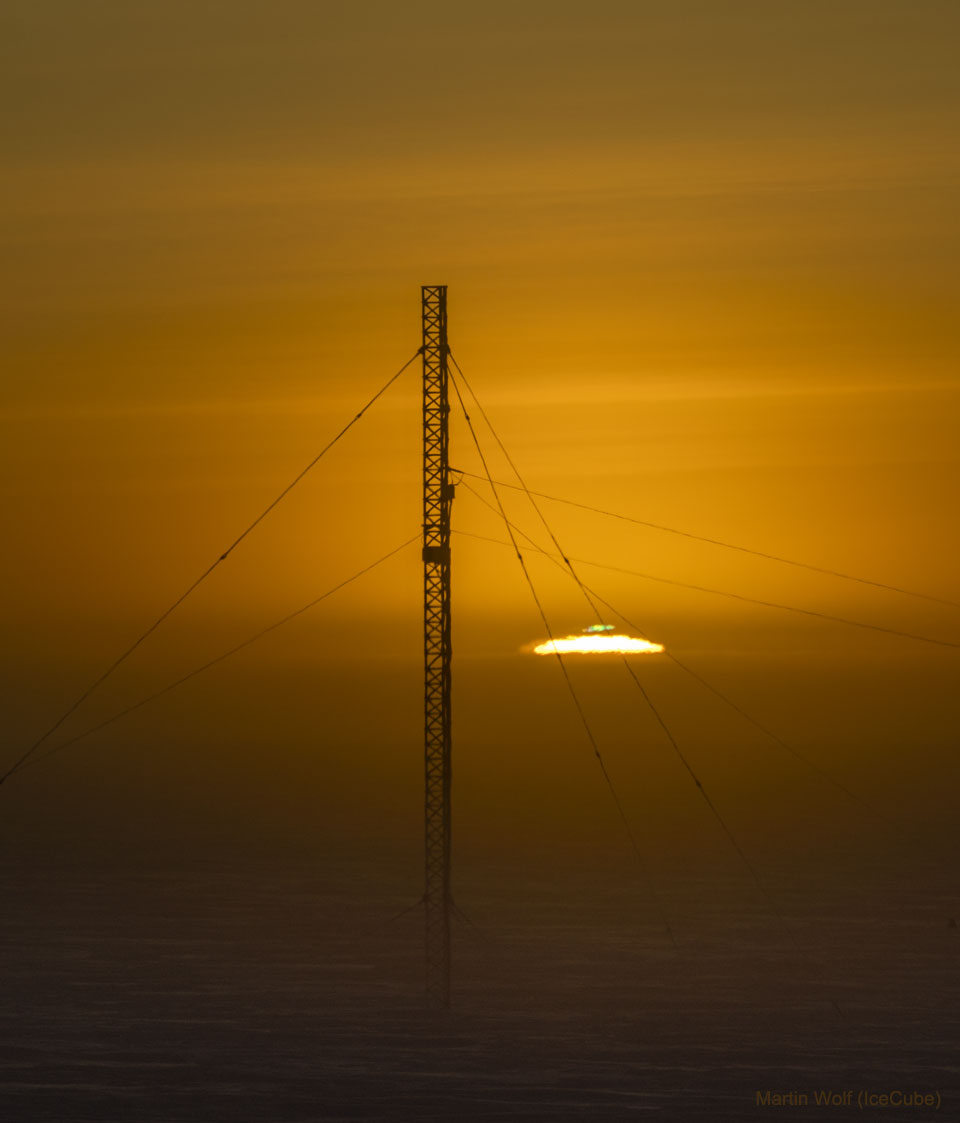
Sunrise at the South Pole is different. Usually a welcome sight, it follows months of darkness -- and begins months of sunshine. At Earth's poles, it can take weeks for the Sun to rise, in contrast with hours at any mid-latitude location. Sunrise at a pole is caused by the tilt of the Earth as it orbits the Sun, not by the rotation of the Earth. Although at a pole, an airless Earth would first see first Sun at an equinox, the lensing effect of the Earth's atmosphere and the size of the solar disk causes the top of the Sun to appear about two-weeks early. Pictured two weeks ago, the Sun peeks above the horizon of a vast frozen landscape at Earth's South Pole. The true South Pole is just a few meters to the left of the communications tower. This polar sunrise capture was particularly photogenic as the Sun appeared capped by a green flash.