The Sun
The Sun is a yellow dwarf star (G2V), about 4.6 billion years old, and the dominant gravitational force in the Solar System. It has a diameter of roughly 1.4 million kilometers and contains around 99.8% of the Solar System’s mass. Nuclear fusion in its core converts hydrogen into helium, producing energy that warms the planets. Above the core lie the radiative and convective zones, followed by the visible photosphere (~5,500 °C), the chromosphere, and the much hotter corona (~2 million °C).
Source: science.nasa.gov
APODs including "The Sun"
Lunar Eclipse over a Skyscraper
22/11/2021
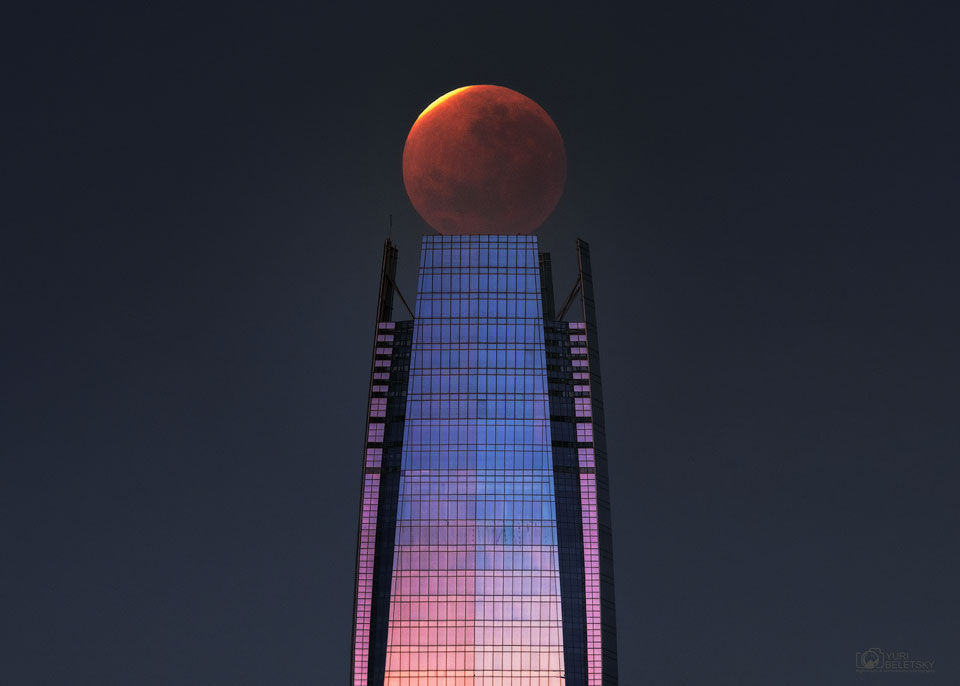
Why is the Moon on top of this building? Planning. It took the astrophotographer careful planning -- including figuring out exactly where to place the camera and exactly when to take the shot -- to create this striking superposition. The single image featured was taken in the early morning hours of November 19, near the peak of the partial lunar eclipse that was occurring as the Moon passed through the Earth's shadow. At this time, almost the entire Moon -- 99.1 percent of its area -- was in the darkest part of the Earth's shadow. The building is the Gran Torre Santiago building in Chile, the tallest building in South America. Although the entire eclipse lasted an impressive six hours, this image had to be taken within just a few seconds to get the alignment right -- the Earth's rotation soon moved the building out of alignment. The next Earth-Moon eclipse will be a total eclipse of the Sun that will occur on December 4 -- but only be visible from the bottom of our world. APOD Editor (RJN) Online Monday: NASA's Best Space Images (& Videos) Notable APOD Submissions: Lunar Eclipse of 2021 November 19