The Sun
The Sun is a yellow dwarf star (G2V), about 4.6 billion years old, and the dominant gravitational force in the Solar System. It has a diameter of roughly 1.4 million kilometers and contains around 99.8% of the Solar System’s mass. Nuclear fusion in its core converts hydrogen into helium, producing energy that warms the planets. Above the core lie the radiative and convective zones, followed by the visible photosphere (~5,500 °C), the chromosphere, and the much hotter corona (~2 million °C).
Source: science.nasa.gov
APODs including "The Sun"
A Total Eclipse of the Sun
09/12/2021
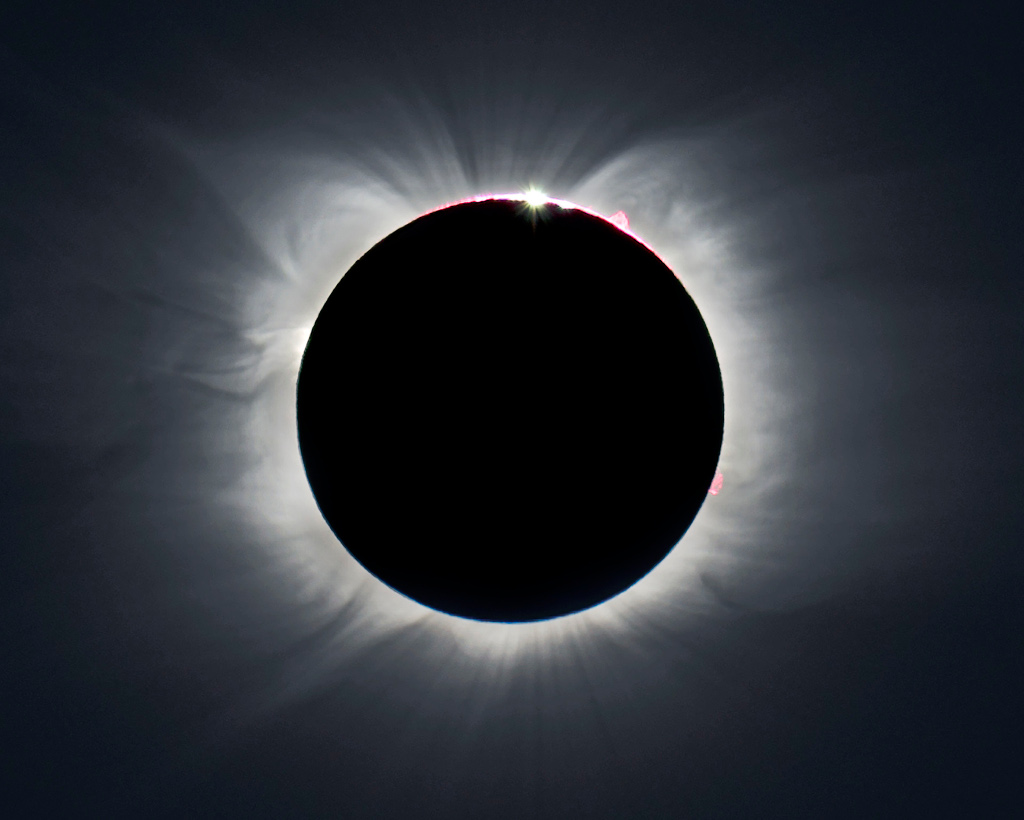
Few were able to stand in the Moon's shadow and watch the December 4 total eclipse of the Sun. Determined by celestial mechanics and not geographical boundaries, the narrow path of totality tracked across planet Earth's relatively inaccessible southernmost continent. Still, some enthusiastic and well-insulated eclipse chasers were rewarded with the dazzling spectacle in Antarctica's cold but clear skies. Taken just before the brief totality began, this image from a ground-based telescope inside the edge of the shadow path at Union Glacier catches a glimmer of sunlight near the top of the silhouetted lunar disk. Look closely for the pinkish solar prominences arcing above the Sun's limb. During totality, the magnificent solar corona, the Sun's outer atmosphere, made its much anticipated appearance, seen in the composite view streaming far from the Sun's edge.