The Sun
The Sun is a yellow dwarf star (G2V), about 4.6 billion years old, and the dominant gravitational force in the Solar System. It has a diameter of roughly 1.4 million kilometers and contains around 99.8% of the Solar System’s mass. Nuclear fusion in its core converts hydrogen into helium, producing energy that warms the planets. Above the core lie the radiative and convective zones, followed by the visible photosphere (~5,500 °C), the chromosphere, and the much hotter corona (~2 million °C).
Source: science.nasa.gov
APODs including "The Sun"
Postcard from the South Pole
11/12/2021
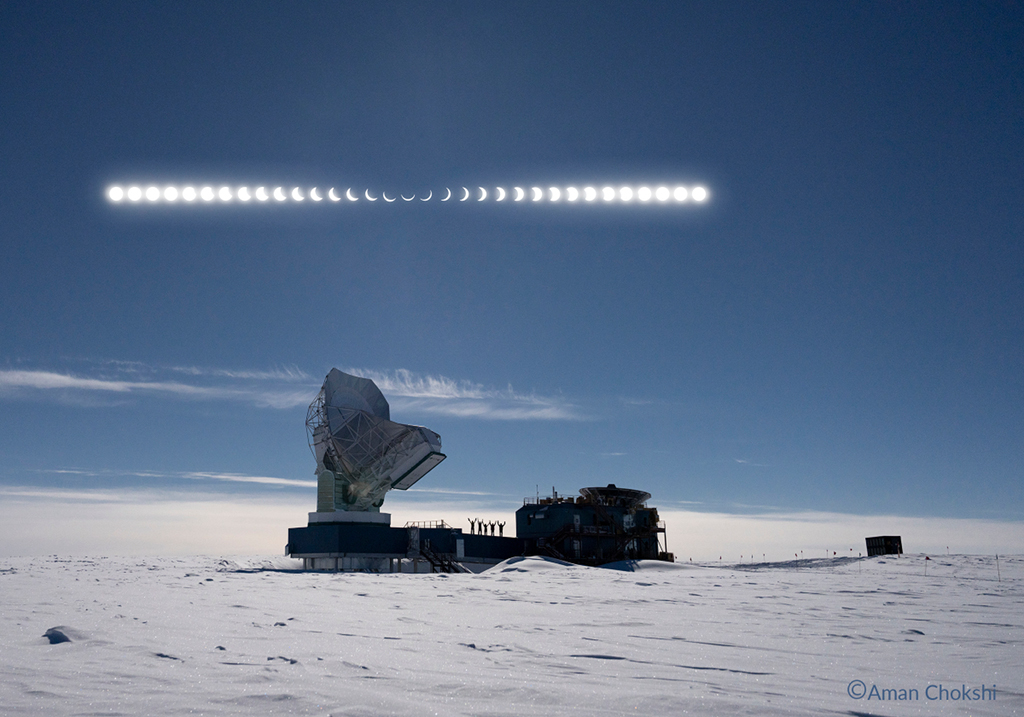
From this vantage point about three quarters of a mile from planet Earth's geographic South Pole, the December 4 eclipse of the Sun was seen as a partial eclipse. At maximum the New Moon blocked 90 percent of the solar disk. Of course, crews at the South Pole Telescope (left) and BICEP telescope (right) climbed to the roof of Amundsen-Scott station's Dark Sector Laboratory to watch. Centered near the local eclipse maximum, the composite timelapse view features an image of the Sun traversing cold antarctic skies taken every four minutes. Left to right along the roof line it also features the raised arms of Brandon Amat, Aman Chokshi, Cheng Zhang, James Bevington and Allen Foster.