The Sun
The Sun is a yellow dwarf star (G2V), about 4.6 billion years old, and the dominant gravitational force in the Solar System. It has a diameter of roughly 1.4 million kilometers and contains around 99.8% of the Solar System’s mass. Nuclear fusion in its core converts hydrogen into helium, producing energy that warms the planets. Above the core lie the radiative and convective zones, followed by the visible photosphere (~5,500 °C), the chromosphere, and the much hotter corona (~2 million °C).
Source: science.nasa.gov
APODs including "The Sun"
A Year of Sunrises
05/01/2022
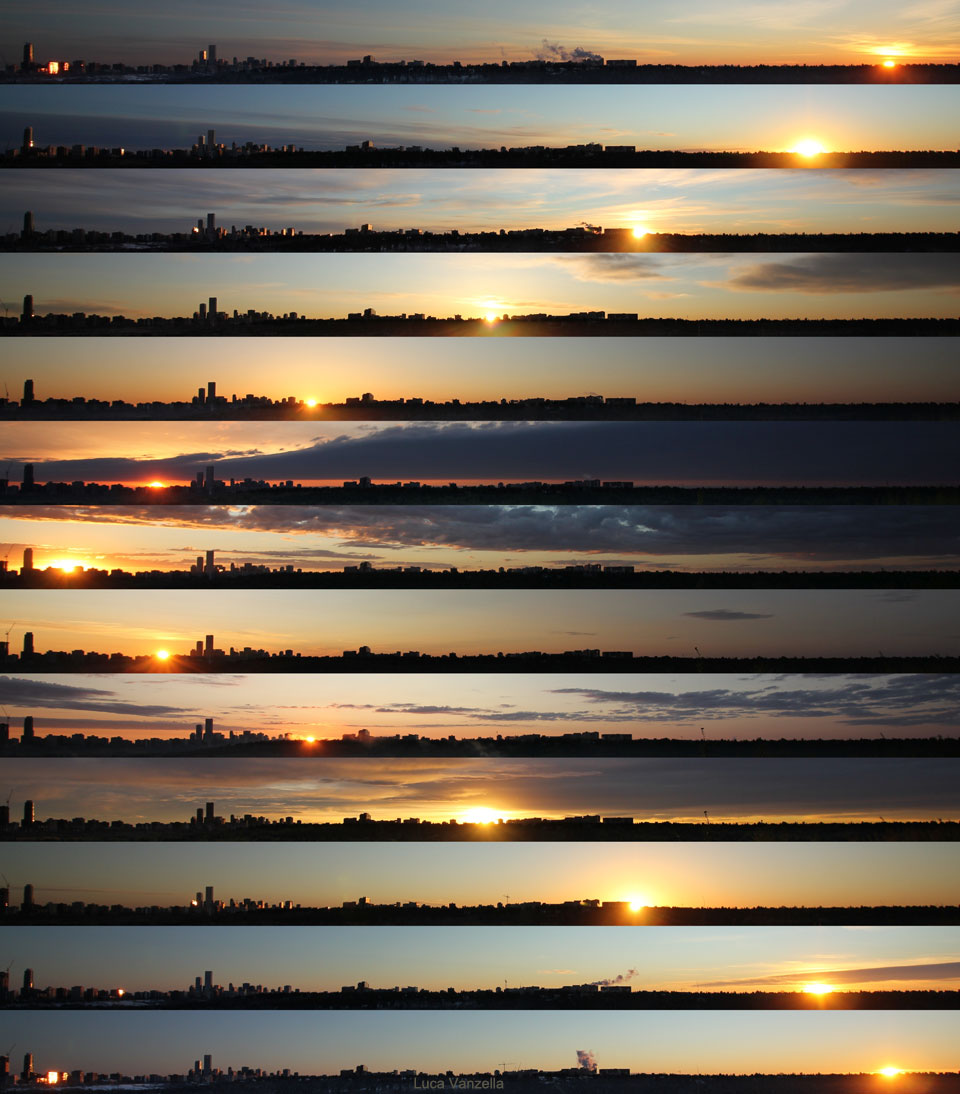
Does the Sun always rise in the same direction? No. As the months change, the direction toward the rising Sun changes, too. The featured image shows the direction of sunrise every month during 2021 as seen from the city of Edmonton, Alberta, Canada. The camera in the image is always facing due east, with north toward the left and south toward the right. As shown in an accompanying video, the top image was taken in 2020 December, while the bottom image was captured in 2021 December, making 13 images in total. Although the Sun always rises in the east in general, it rises furthest to the south of east near the December solstice, and furthest north of east near the June solstice. In many countries, the December Solstice is considered an official change in season: for example the first day of winter in the North. Solar heating and stored energy in the Earth's surface and atmosphere are near their lowest during winter, making the winter season the coldest of the year. Status Updates: Deploying the James Webb Space Telescope