The Sun
The Sun is a yellow dwarf star (G2V), about 4.6 billion years old, and the dominant gravitational force in the Solar System. It has a diameter of roughly 1.4 million kilometers and contains around 99.8% of the Solar System’s mass. Nuclear fusion in its core converts hydrogen into helium, producing energy that warms the planets. Above the core lie the radiative and convective zones, followed by the visible photosphere (~5,500 °C), the chromosphere, and the much hotter corona (~2 million °C).
Source: science.nasa.gov
APODs including "The Sun"
The Last Days of Venus as the Evening Star
06/01/2022
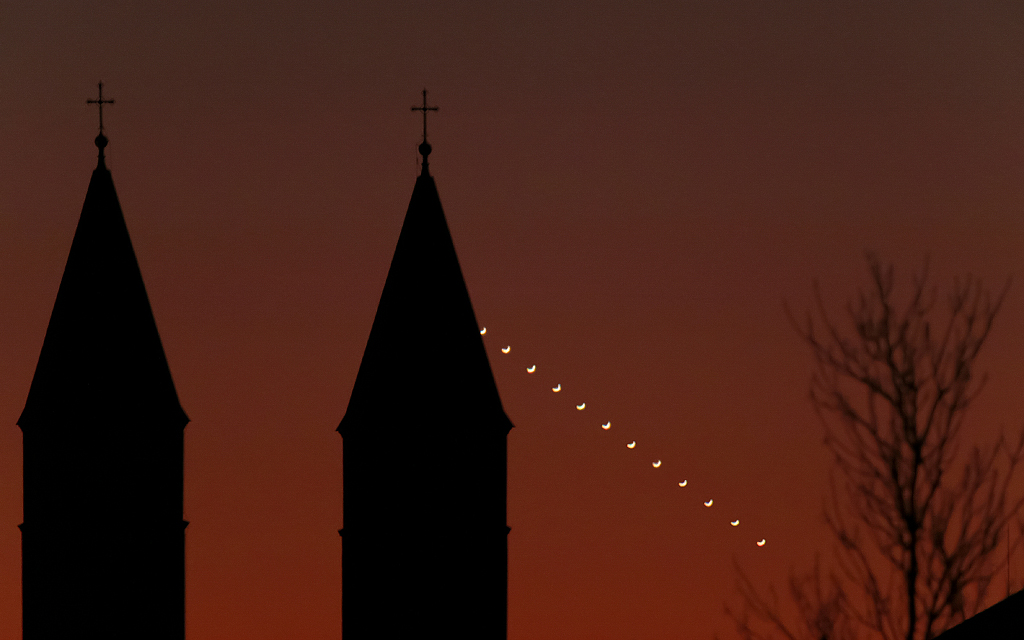
That's not a young crescent Moon posing behind cathedral towers after sunset. It's Venus in a crescent phase. About 40 million kilometers away and about 2 percent illuminated by sunlight, it was captured with camera and telephoto lens in this series of exposures as it set in western skies on January 1 from Veszprem, Hungary. The bright celestial beacon was languishing in the evening twilight, its days as the Evening Star coming to a close as 2022 began. But it was also growing larger in apparent size and becoming an ever thinner crescent in telescopic views. Heading toward a (non-judgemental) inferior conjunction, the inner planet will be positioned between Earth and Sun on January 9 and generally lost from view in the solar glare. A crescent Venus will soon reappear though. Rising in the east by mid-month just before the Sun as the brilliant Morning Star. Status Updates: Deploying the James Webb Space Telescope