The Sun
The Sun is a yellow dwarf star (G2V), about 4.6 billion years old, and the dominant gravitational force in the Solar System. It has a diameter of roughly 1.4 million kilometers and contains around 99.8% of the Solar System’s mass. Nuclear fusion in its core converts hydrogen into helium, producing energy that warms the planets. Above the core lie the radiative and convective zones, followed by the visible photosphere (~5,500 °C), the chromosphere, and the much hotter corona (~2 million °C).
Source: science.nasa.gov
APODs including "The Sun"
Embraced by Sunlight
03/02/2022
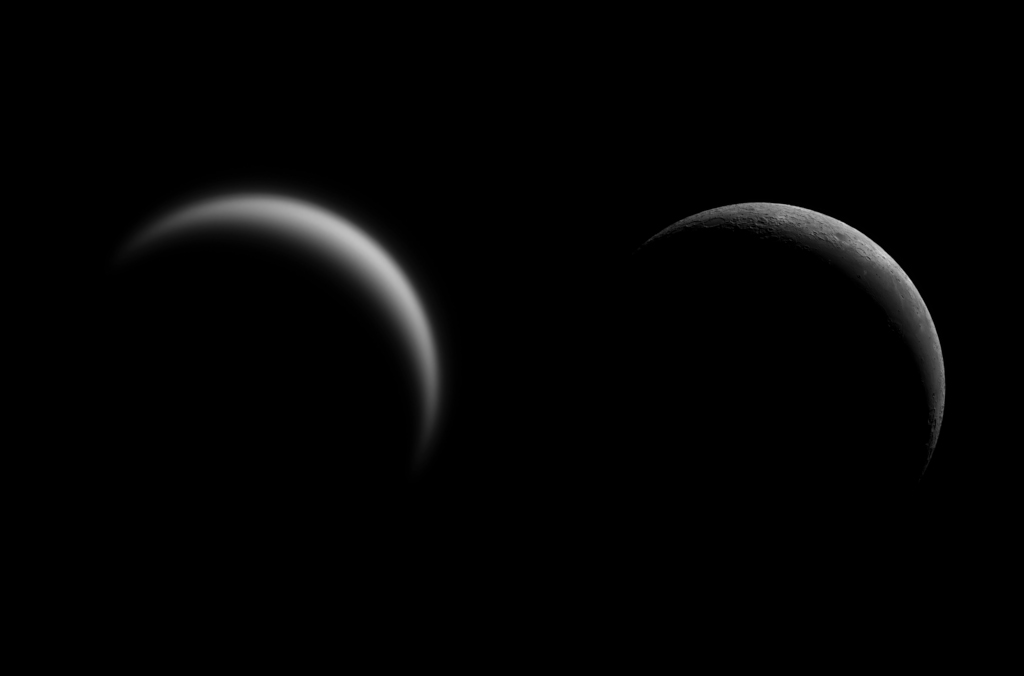
ven though Venus (left) was the brightest planet in the sky it was less than 1/30th the apparent size of the Moon on January 29. But as both rose before the Sun they shared a crescent phase, and for a moment their visible disks were each about 12 percent illuminated as they stood above the southeastern horizon. The similar sunlit crescents were captured in these two separate images. Made at different magnifications, each panel is a composite of stacked video frames taken with a small telescope. Venus goes through a range of phases like the Moon as the inner planet wanders from evening sky to morning sky and back again with a period of 584 days. Of course the Moon completes its own cycle of phases, a full lunation, in about 29.5 days.