The Sun
The Sun is a yellow dwarf star (G2V), about 4.6 billion years old, and the dominant gravitational force in the Solar System. It has a diameter of roughly 1.4 million kilometers and contains around 99.8% of the Solar System’s mass. Nuclear fusion in its core converts hydrogen into helium, producing energy that warms the planets. Above the core lie the radiative and convective zones, followed by the visible photosphere (~5,500 °C), the chromosphere, and the much hotter corona (~2 million °C).
Source: science.nasa.gov
APODs including "The Sun"
Direct Projection: The Moon in My Hands
28/02/2022
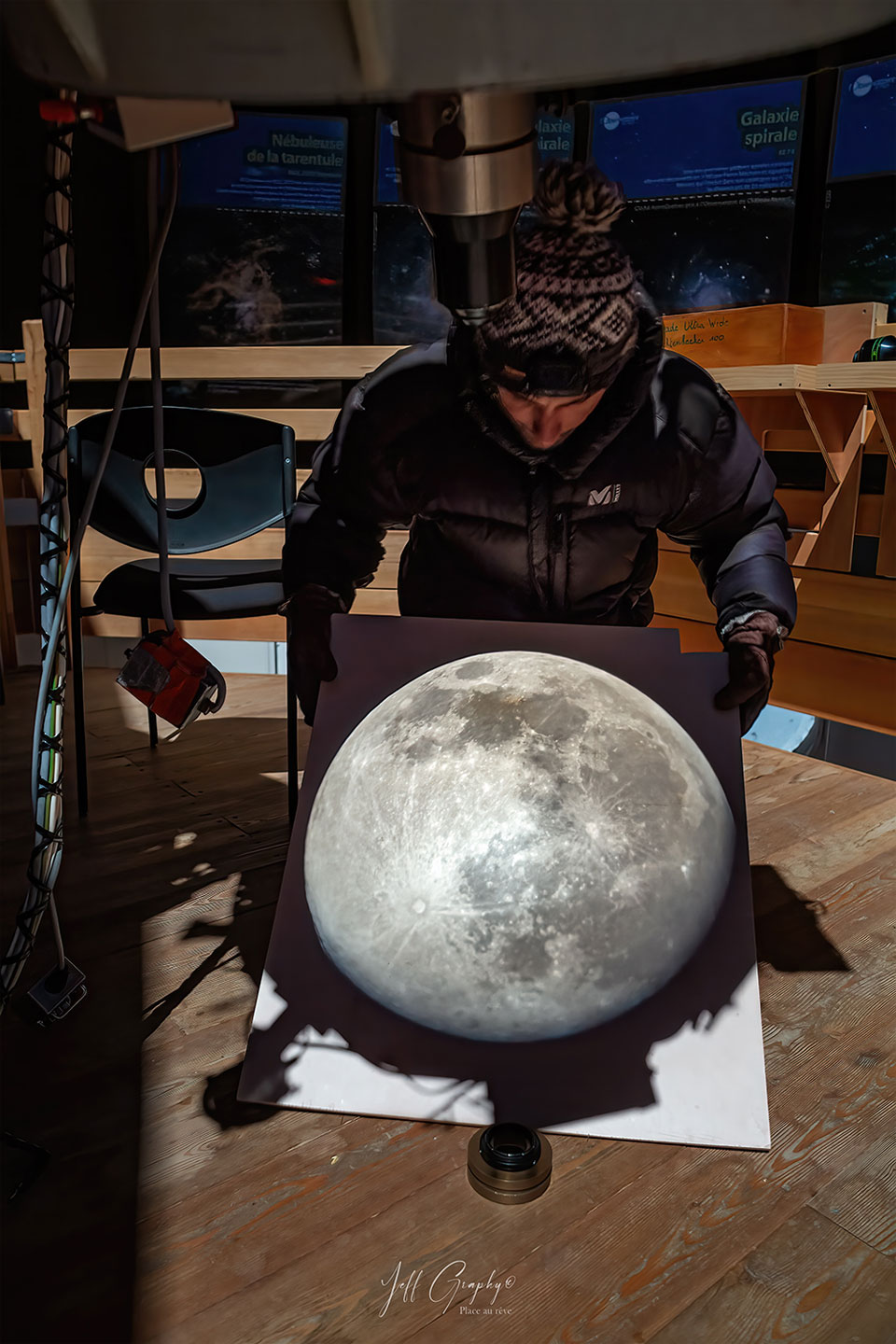
You don't have to look through a telescope to know where it's pointing. Allowing the telescope to project its image onto a large surface can be useful because it dilutes the intense brightness of very bright sources. Such dilution is useful for looking at the Sun, for example during a solar eclipse. In the featured single-exposure image, though, it is a too-bright full moon that is projected. This February full moon occurred two weeks ago and is called the Snow Moon by some northern cultures. The projecting instrument is the main 62-centimeter telescope at the Saint-Véran Observatory high in the French Alps. Seeing a full moon directly is easier because it is not too bright, although you won't see this level of detail. Your next chance will occur on March 17.