The Sun
The Sun is a yellow dwarf star (G2V), about 4.6 billion years old, and the dominant gravitational force in the Solar System. It has a diameter of roughly 1.4 million kilometers and contains around 99.8% of the Solar System’s mass. Nuclear fusion in its core converts hydrogen into helium, producing energy that warms the planets. Above the core lie the radiative and convective zones, followed by the visible photosphere (~5,500 °C), the chromosphere, and the much hotter corona (~2 million °C).
Source: science.nasa.gov
APODs including "The Sun"
Record Prominence Imaged by Solar Orbiter
02/03/2022
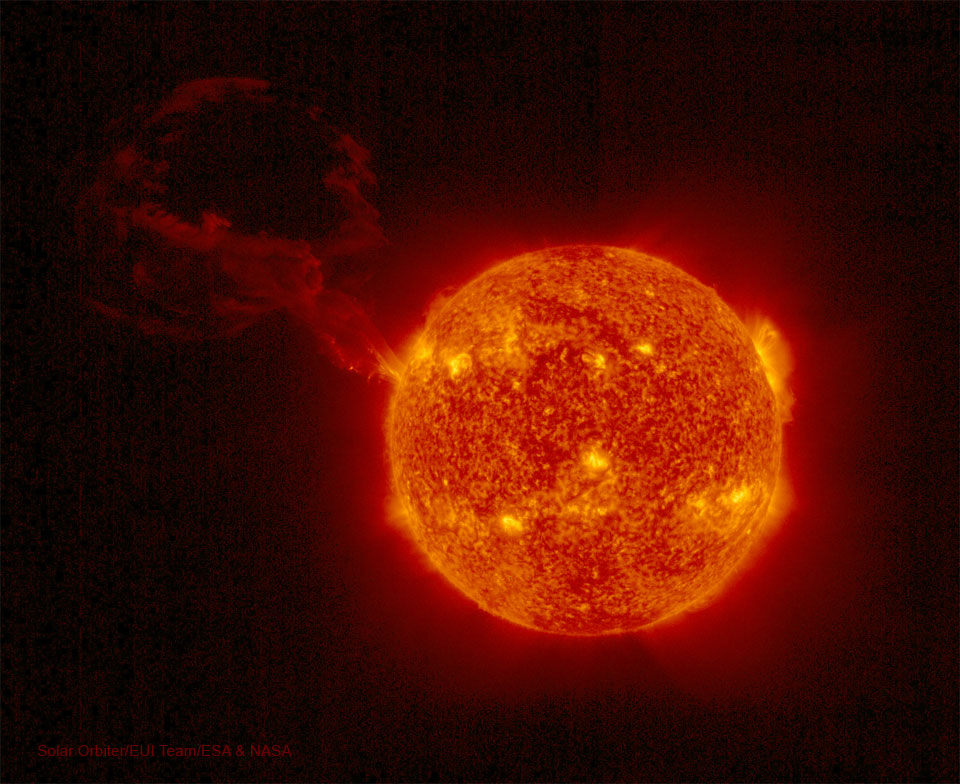
What's happened to our Sun? Last month, it produced the largest prominence ever imaged together with a complete solar disk. The record image, featured, was captured in ultraviolet light by the Sun-orbiting Solar Orbiter spacecraft. A quiescent solar prominence is a cloud of hot gas held above the Sun's surface by the Sun's magnetic field. This solar prominence was huge -- spanning a length rivaling the diameter of the Sun itself. Solar prominences may erupt unpredictably and expel hot gas into the Solar System via a Coronal Mass Ejection (CME). When a CME strikes the Earth and its magnetosphere, bright auroras may occur. This prominence did produce a CME, but it was directed well away from the Earth. Although surely related to the Sun's changing magnetic field, the energy mechanism that creates and sustains a solar prominence remains a topic of research.