The Sun
The Sun is a yellow dwarf star (G2V), about 4.6 billion years old, and the dominant gravitational force in the Solar System. It has a diameter of roughly 1.4 million kilometers and contains around 99.8% of the Solar System’s mass. Nuclear fusion in its core converts hydrogen into helium, producing energy that warms the planets. Above the core lie the radiative and convective zones, followed by the visible photosphere (~5,500 °C), the chromosphere, and the much hotter corona (~2 million °C).
Source: science.nasa.gov
APODs including "The Sun"
Colorful Airglow Bands Surround Milky Way
13/03/2022
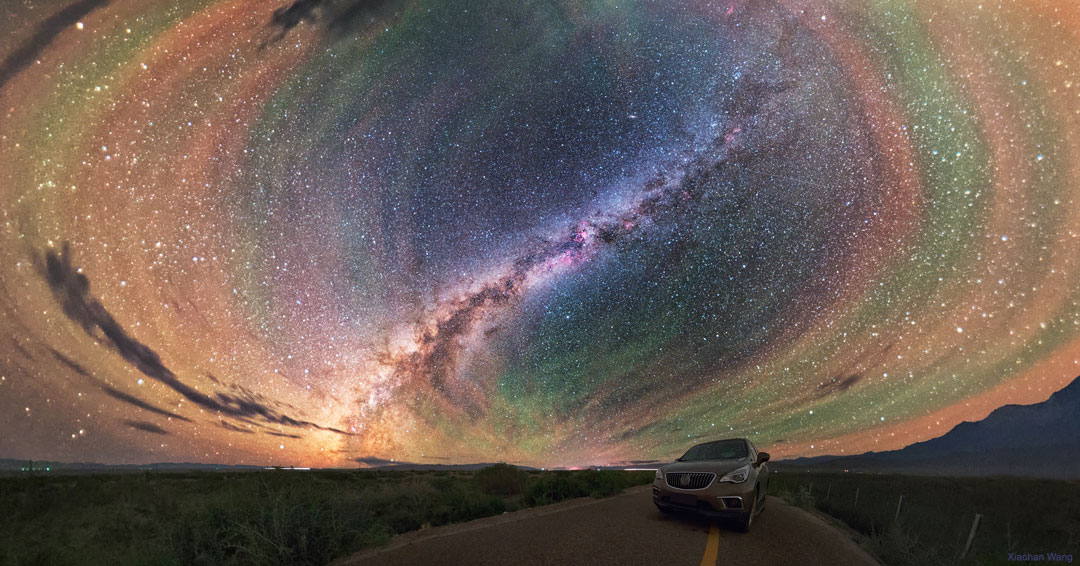
Why would the sky glow like a giant repeating rainbow? Airglow. Now air glows all of the time, but it is usually hard to see. A disturbance however -- like an approaching storm -- may cause noticeable rippling in the Earth's atmosphere. These gravity waves are oscillations in air analogous to those created when a rock is thrown in calm water. Red airglow likely originates from OH molecules about 87-kilometers high, excited by ultraviolet light from the Sun, while orange and green airglow is likely caused by sodium and oxygen atoms slightly higher up. While driving near Keluke Lake in Qinghai Provence in China a few years ago, the photographer originally noticed mainly the impressive central band of the Milky Way Galaxy. Stopping to photograph it, surprisingly, the resulting sensitive camera image showed airglow bands to be quite prominent and span the entire sky. The featured image has been digitally enhanced to make the colors more vibrant.