The Sun
The Sun is a yellow dwarf star (G2V), about 4.6 billion years old, and the dominant gravitational force in the Solar System. It has a diameter of roughly 1.4 million kilometers and contains around 99.8% of the Solar System’s mass. Nuclear fusion in its core converts hydrogen into helium, producing energy that warms the planets. Above the core lie the radiative and convective zones, followed by the visible photosphere (~5,500 °C), the chromosphere, and the much hotter corona (~2 million °C).
Source: science.nasa.gov
APODs including "The Sun"
A Filament in Monoceros
18/03/2022
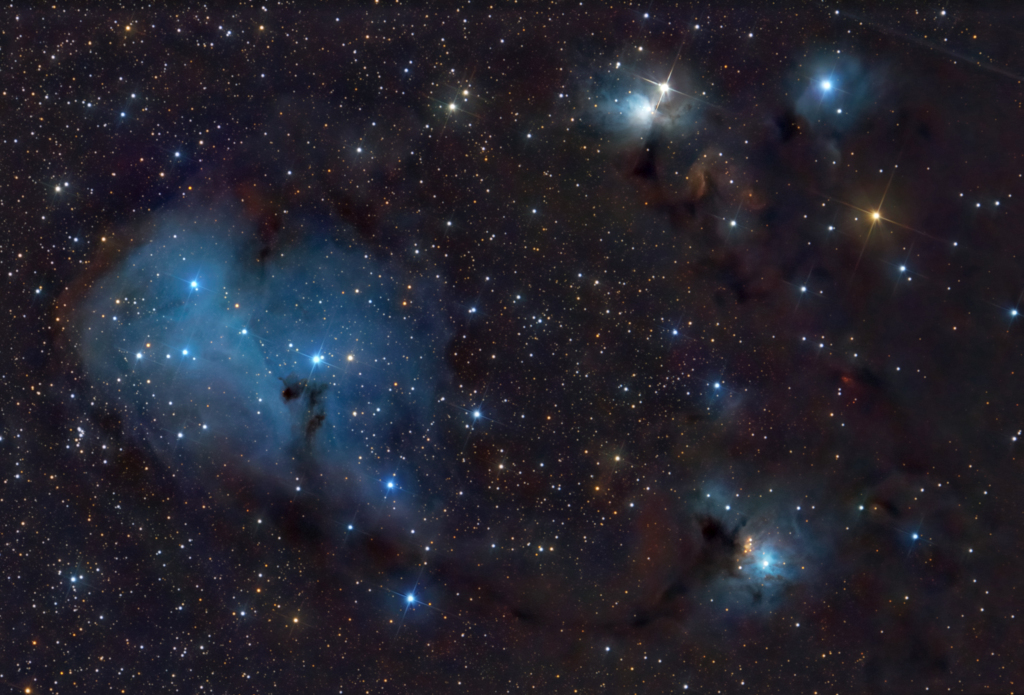
Bluish reflection nebulae seem to fill this dusty expanse. The sharp telescopic frame spans over 1 degree on the sky toward the faint but fanciful constellation Monoceros, the Unicorn. Seen within the Monoceros R1 cloud complex some 2,500 light-years away, bluish IC 447 is on the left, joined by a long dark filament of dust to IC 446 at lower right. Embedded in IC 447 are young, massive blue stars much hotter than the Sun, whose light is reflected by the cosmic cloud of star stuff. Observations reveal that IC 446 also contains a young stellar object, a massive star still in an early stage of evolution. The dark filament of dust and molecular gas joining the two star-forming regions is over 15 light-years long.