The Sun
The Sun is a yellow dwarf star (G2V), about 4.6 billion years old, and the dominant gravitational force in the Solar System. It has a diameter of roughly 1.4 million kilometers and contains around 99.8% of the Solar System’s mass. Nuclear fusion in its core converts hydrogen into helium, producing energy that warms the planets. Above the core lie the radiative and convective zones, followed by the visible photosphere (~5,500 °C), the chromosphere, and the much hotter corona (~2 million °C).
Source: science.nasa.gov
APODs including "The Sun"
Titan Seas Reflect Sunlight
27/03/2022
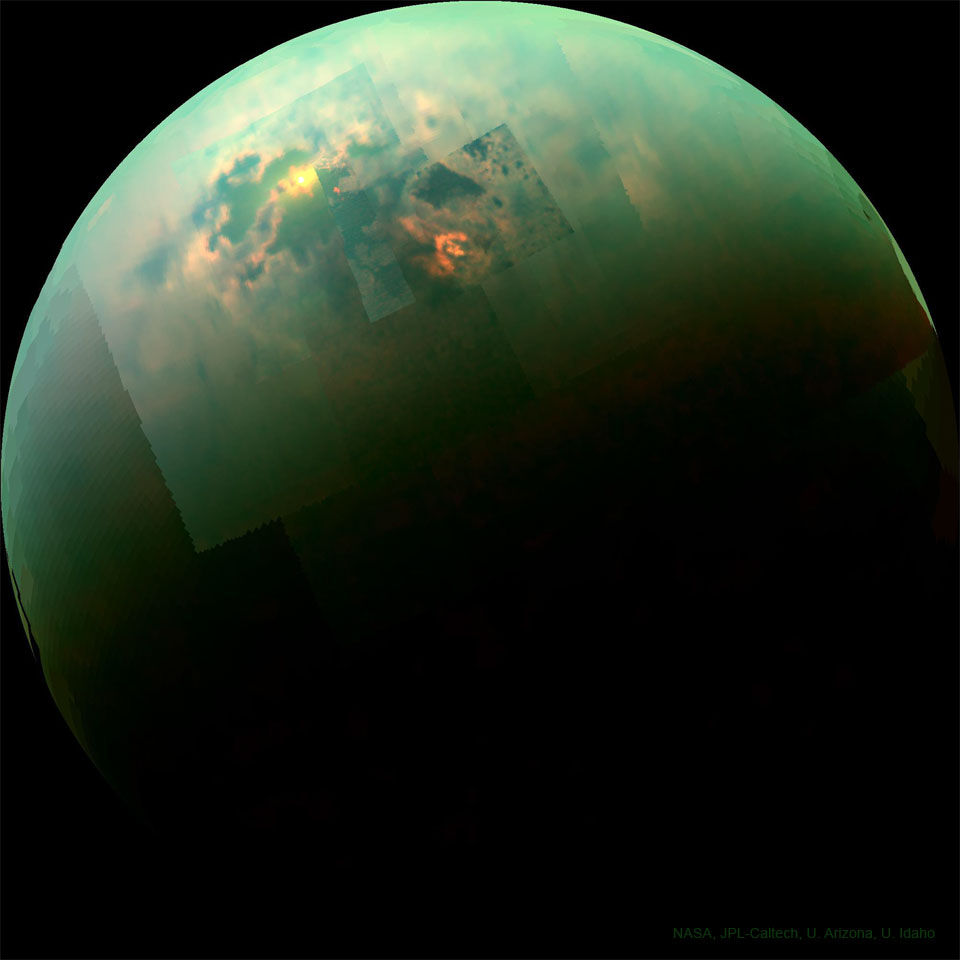
Why would the surface of Titan light up with a blinding flash? The reason: a sunglint from liquid seas. Saturn's moon Titan has numerous smooth lakes of methane that, when the angle is right, reflect sunlight as if they were mirrors. Pictured here in false-color, the robotic Cassini spacecraft that orbited Saturn from 2004 to 2017 imaged the cloud-covered Titan in 2014 in different bands of cloud-piercing infrared light. This specular reflection was so bright it saturated one of Cassini's infrared cameras. Although the sunglint was annoying -- it was also useful. The reflecting regions confirm that northern Titan houses a wide and complex array of seas with a geometry that indicates periods of significant evaporation. During its numerous passes of our Solar System's most mysterious moon, Cassini has revealed Titan to be a world with active weather -- including times when it rains a liquefied version of natural gas.