The Sun
The Sun is a yellow dwarf star (G2V), about 4.6 billion years old, and the dominant gravitational force in the Solar System. It has a diameter of roughly 1.4 million kilometers and contains around 99.8% of the Solar System’s mass. Nuclear fusion in its core converts hydrogen into helium, producing energy that warms the planets. Above the core lie the radiative and convective zones, followed by the visible photosphere (~5,500 °C), the chromosphere, and the much hotter corona (~2 million °C).
Source: science.nasa.gov
APODs including "The Sun"
Planet Line over New York Bridge
20/04/2022
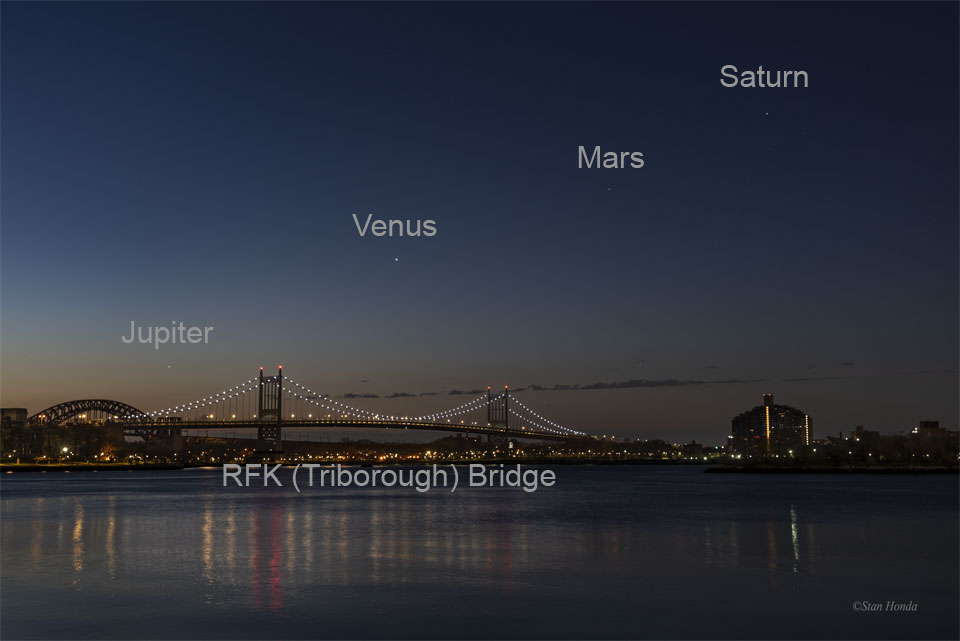
There's an interesting sky to see if you wake up before the Sun. Lined up on toward the eastern horizon are four planets in a row. The planets are so bright they can even be seen from the bright sky inside a city. In fact, the featured image was taken from New York City, USA, with the foreground highlighted by the RFK (Triborough) Bridge. Pictured, the planets are, left to right, Jupiter, Venus, Mars, and Saturn. The planets all appear in a row because they all orbit the Sun in the same plane. This plane, called the ecliptic plane, was created in the early days of our Solar System and includes all planets, including Earth. The morning planet parade will continue throughout April and May, and will even be joined by Mercury in June. APOD volunteer programming opportunity: Discord